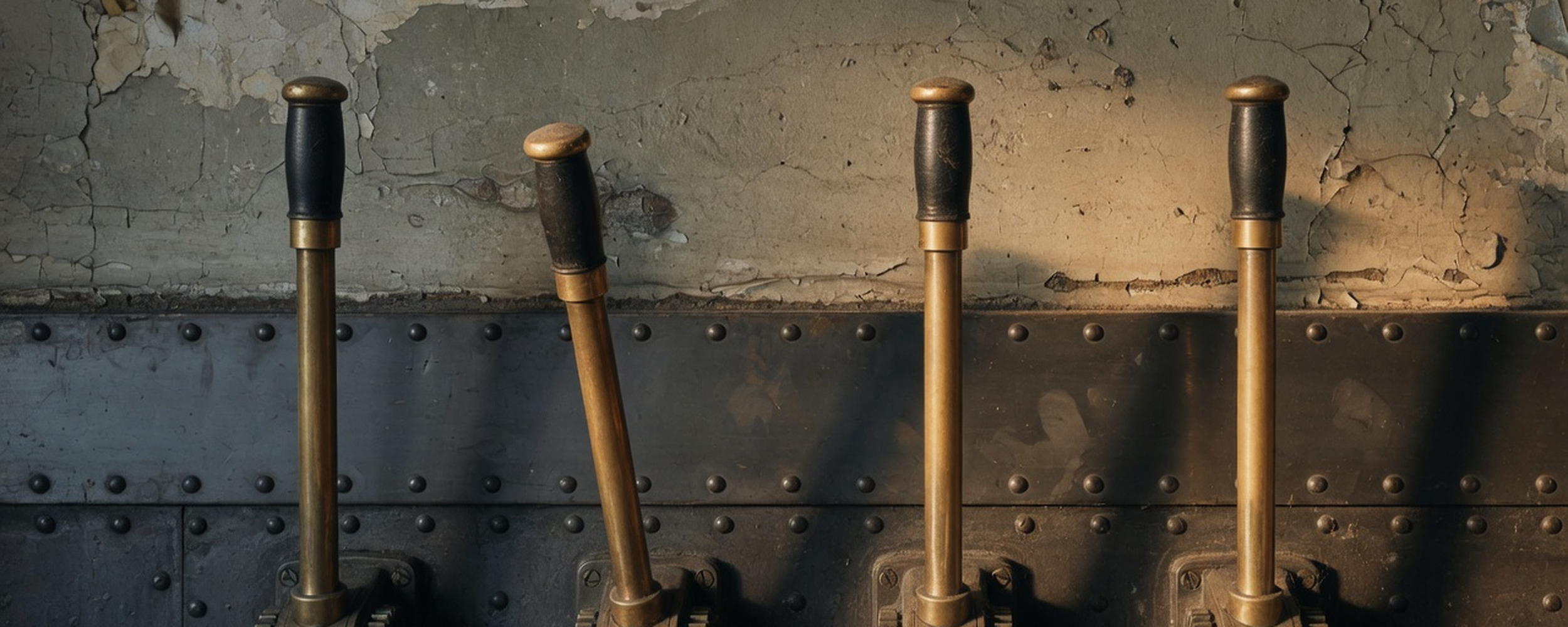
Control does not need a villain. It needs four levers.
What if control doesn’t need a villain — just four levers?
A meeting, a family table, a team chat: the range of what can be said starts to shrink. The first move is often to hunt a face — a name we can point to, a person who must be doing this. Sometimes there is one. Often there is not. High-control patterns can arrive as four ordinary levers, pulled by ordinary people, in a company, a movement, a family, or a platform.
The useful question is not “who is doing this to us?” first. It is “which lever just moved?” Naming the lever keeps the story sized to the room. It also keeps us from missing a pattern because nobody present looks like a villain.
Four levers, not a monster
High-control patterns show up wherever a group needs people to stay aligned under pressure. They are not a special species of evil. They are techniques for reducing the range of what can be said, done, felt, and thought. We can name them without a courtroom.
- Information: who we may hear, which sources count, what may be asked.
- Behavior: where we go, how hours are spent, who we sit with, what we must perform.
- Emotion: which feelings are allowed, which must be confessed or swallowed.
- Thought: which questions may be turned over, which answers are the only loyal ones.
The first of those has an older name. Milieu control is the systematic regulation of communication and information flow inside an environment, until the environment becomes the main place we test what is real. Robert Jay Lifton described it as control of human communication — incoming and outgoing — so that a single interpretive frame does most of the work. It can start as a rule about which books, which feeds, which people we may consult. It can end as self-censorship: we stop bringing the outside in, because the outside has been priced as dirty or naive or unsafe.
We do not need a prison for this. A team that only circulates one dashboard, a family that treats certain questions as betrayal, a platform that buries dissenting posts, a movement that floods the day with approved talk — each is pulling the information lever. Isolation does not have to be geographic. It can be social. It can be a joke that lands every time someone cites an unapproved source. Once the inputs narrow, the room starts to feel like the only map.

The other three, in ordinary rooms
Behavior is the most visible lever. Hours. Dress. Attendance. Who we may eat with, leave the building with, or fail to show up for. Social influence research has long shown that people change what they do under the real or imagined presence of others. Compliance can happen without a change of heart — a yes on the outside, the old view still sitting inside. Obedience can happen under a title and a tone. None of that is rare. Workplaces run on it. Families run on it. The question is range: how much of the day is already decided for us, and what happens if we step off the line.
Emotion is quieter. A room can teach us which feelings are proof of loyalty and which are proof of a problem. Shame, fear, and the wish to belong are cheap fuel. So is a sudden warmth when we say the right sentence. We are not machines. A group that praises one feeling and pathologizes another is not always being cruel. It is often being efficient. Efficiency is not the same as care. If sadness in the wrong direction gets treated as a character issue, the body will learn to hide it.
Thought is the last lever, and the easiest to miss from the inside. If information is what we are allowed to hear, thought is what we are allowed to turn over. Some groups hand us a finished sentence and call the turning itself a risk. Doubt becomes a leak. Curiosity becomes a loyalty test we did not know we were sitting. We start to run the check before the thought is even finished: would this be safe to say out loud? That is not the same as having been persuaded. Persuasion leaves a trail of reasons. The thought lever often leaves a trail of pauses.

How the room gets quiet in the same direction
Group conformity is the tendency to shift what we say — and sometimes what we think we see — toward the people around us. Solomon Asch’s line-judgment studies made this plain in the early 1950s. The task was easy. Alone, people almost never missed it. In a unanimous group giving the wrong answer, a substantial share of trials produced public agreement with the error. Most people went along at least once. Unanimity mattered more than headcount. When even one other person broke the run of wrong answers, conformity dropped sharply. We do not need a mob. We need a table that does not leave a chair for dissent.
Two engines sit under that. Informational influence is using the group as a clue about reality when we are unsure. Normative social influence is the wish not to be the odd one — to gain approval or avoid rejection, even when we privately disagree. Morton Deutsch and Harold Gerard separated those in 1955. Public settings raise the second engine. Anonymity lowers it. The first engine is not a trick. Sometimes the group really does know something we do not. The trouble starts when both engines run at once, and the only available map is the one the room already printed.
Normative pressure is how the four levers stay cheap. If the information lever has already narrowed the inputs, the group feels like the only map. If the behavior lever has already filled the hours, there is less room to go looking. If the emotion lever has made disagreement feel like harm, the body will close the thought for us. None of this requires a mastermind. It requires a pattern that rewards the freeze.
Name which lever moved
We do not have to leave every group. Influence is how we learn language, traffic, and how not to wreck a dinner. We need a name for the move when the range starts to shrink.
Name which lever moved.
Was it information — a source quietly dropped, a question treated as unsafe, a feed that only shows one weather? Was it behavior — a new rule about where we sit, who we speak to, how the weekend must look? Was it emotion — a sudden coldness when we were sad in the wrong way, a warmth when we performed the right feeling? Was it thought — a sentence we were not allowed to finish, even in private?
Naming the lever is not an accusation. Once we can say which line moved, we can decide, without a scene, whether to push back, step out, or stay and keep a private seam. The point is not that all influence is harm. The point is range and cost. When four levers move together, the room starts to feel like the whole world. It is still a room. We can count the walls.