
The first explanation is not the facts.
Why does one missed text start to feel like we already know what happened?
They didn’t text back. We decide they’re mad.
It feels like we read it. Like it’s already true.
That’s not us being good at people. That’s the first explanation closing the question so we can rest.
The first explanation is not the facts. It’s just the one that got there first.
The empty chair writes a sentence. We treat the sentence as a report.
We’re at a table set for two. The other chair is empty. A coat is still there. The water glass is full. The first sentence that arrives is not a list of options. It is a finished story: they blew us off. They’re late on purpose. They’re mad.
Traffic does not arrive as fast as that sentence. A dead phone does not arrive as fast. A kid who wouldn’t put shoes on does not arrive as fast. The gap in the chair is loud. The first story is the one that fills the gap so we can sit with something instead of with nothing.
A missed text is that chair, in a smaller room. Silence is not a message. We still hear one.

The hard question and the easy one
The hard question is: what happened? That question needs facts we do not have. They didn’t reply. That is the fact. Mad is not in the thread. Mad is in us.
The easy question is: how does this silence feel? It feels like rejection. It feels like a door closing. It feels like last time. That feeling is fast. It is already in the body before we have checked a clock.
In 2002, Daniel Kahneman and Shane Frederick described a move like this as attribute substitution: when the thing we actually need to judge is hard to get at, we answer a related thing that comes more readily to mind — and often do not notice the swap. Kahneman put it in plainer language a year later: people confronted with a difficult question sometimes answer an easier one instead.
What those pages show: the swap is ordinary. It shows up in probability, in size, in “how happy are you.” The target is hard. A stand-in is easy. The stand-in gets treated as the answer.
What they do not show: a text thread. They did not measure “they’re mad.” They did not prove we are irrational for caring. The useful piece is the swap. “What happened?” is hard. “How does this feel?” is easy. Mad is the easy answer wearing the hard question’s clothes.
That is why it feels like we already know. We answered a question. It just was not the one we think we answered.
A finished wrong answer can feel better than an open true one
There is a second pressure, and it is not about being smart.
Arie Kruglanski and Donna Webster called it the need for cognitive closure: a desire for a firm answer and a dislike of the unfinished question. In their 1996 account it can be a trait, and it can be a state. Time pressure, noise, fatigue, and the simple cost of sitting in not-knowing all raise it. Two moves follow. Seizing: grab the first thing that will close the file. Freezing: keep that thing so the file stays closed.
What that work shows: an unfinished question has a price in the body. People will pay for a definite answer — including a bad one — because definite is a kind of rest. Impression, stereotype, and “they meant this” all get faster when closure is needed now.
What it does not show: that we are closed-minded as a personality. That every missed text is a study. That the first explanation is always wrong. Sometimes they are mad. The point is earlier than true or false. The first explanation closed the question so we could rest. Rest is not the same as a check.
We’re standing at a dark door after a knock. The first story is: they’re ignoring us. The second story is in the driveway. A car is turning in. We cannot see it from the stoop unless we look. The first story did not wait for the look. It was already done.
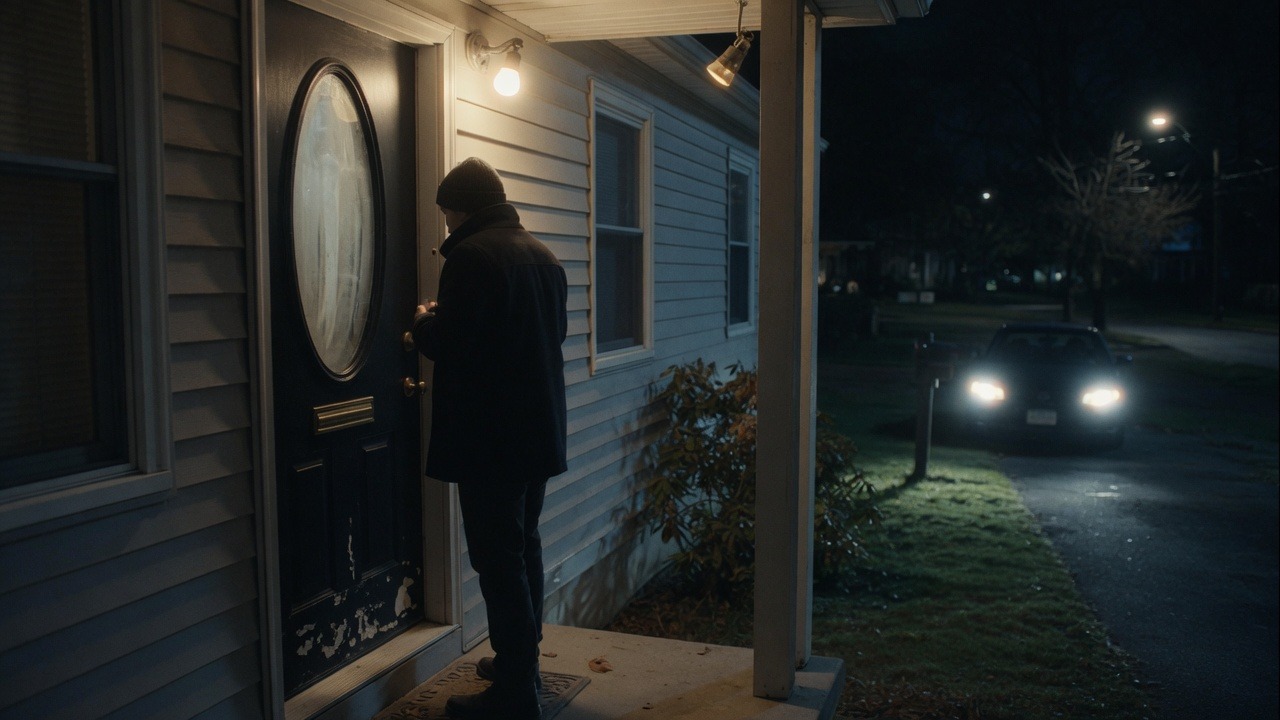
Guessing is not the failure. Stopping at one guess is.
We are going to guess. A silent thread is a gap, and a nervous system fills gaps. The skill is not to become a person who never writes a first line. The skill is not to send the first line to the printer.
A second explanation does a simple job. It keeps the file open long enough for another cause to exist. They’re driving. The phone is in a bag. They fell asleep. They’re choosing words. They’re mad. All of those can sit on the same page. Only one of them was first. First is not a credential.
If we treat the first as the facts, we start answering a person who has not spoken. We get sharp. We write a second text that is actually a verdict. We tell a friend. The story grows a body. Then they reply — they were in a store, they were with a kid, they were in a dead zone — and we have to walk the story back, or we don’t, and we stay mad at a version of them that never happened.
Writing a second explanation is not being naive. It is refusing to let rest pretend it is knowledge.
Why is “they’re mad” so often the first line, and not “they’re in a store”? Because mad is a belonging threat, and belonging threats arrive fast. A person we care about going quiet used to be a real problem in a small group we could not leave. The body still treats a silent thread like a silent face across a fire. That does not make the story true. It makes it early. Early is the whole problem.
The second explanation does not have to be pretty. It has to be different. They’re driving. The phone is face-down in another room. They’re choosing a sentence. They’re in a meeting they cannot leave. Write it somewhere we can see it — notes, a scrap, the body of a text we do not send yet. If it only lives in the head, the first line will eat it. The first line is already warmer. It already has a feeling attached. The second line needs a place to sit or it will not survive the next minute.
We can still send a kind check-in. We do not have to send a verdict. “You around later?” is a question. “I guess you’re mad” is a closed file with their name on it. One of those can still be taken back. The other has already started a fight with a person who has not spoken.
The skill is not never guess. The skill is: write a second explanation before we treat the first one as the facts.
Ask:
- What’s another reason they might not have texted?
- Do we actually know, or do we just have an explanation?
Definitions
- Attribute substitution
- Answering a hard question by swapping in an easier related one — and treating that easier answer as if it were the thing we asked.
- Need for cognitive closure
- The urge to have a firm answer so the question can stop, even when the firm answer arrived too early.
References
- Kahneman, D., & Frederick, S. (2002). Representativeness revisited: Attribute substitution in intuitive judgment. In T. Gilovich, D. Griffin, & D. Kahneman (Eds.), Heuristics and biases: The psychology of intuitive judgment (pp. 49–81). Cambridge University Press. https://doi.org/10.1017/CBO9780511808098.004
- Kahneman, D. (2003). Maps of bounded rationality: Psychology for behavioral economics. American Economic Review, 93(5), 1449–1475. https://doi.org/10.1257/000282803322655392
- Kruglanski, A. W., & Webster, D. M. (1996). Motivated closing of the mind: “Seizing” and “freezing.” Psychological Review, 103(2), 263–283. https://doi.org/10.1037/0033-295X.103.2.263 · author PDF