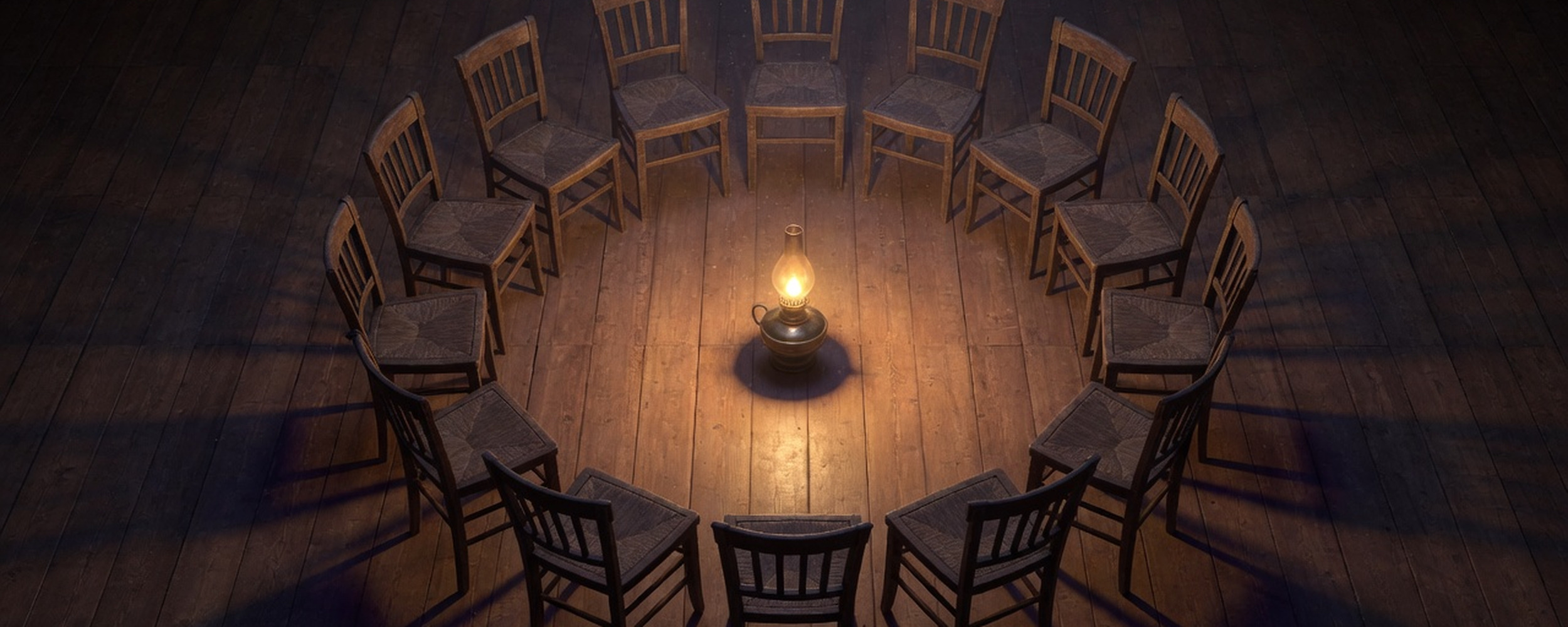
A group of twelve is not the whole world
Why does a group of twelve start to feel like the whole world?
A work chat of a dozen names can fill the whole field of attention. Hearts speed up. Faces matter. Silence has a cost. Several billion other people are still out there, doing other things. The alarms in the body do not first ask how many humans are alive. They ask who can see us right now.
That is old equipment running in a bigger building. The useful work is naming the scale before the heat finishes the argument.
Village-sized alarms in a small room
Robin Dunbar’s work on the social brain starts from a primate pattern: species with relatively more neocortex tend to live in larger stable groups. Extrapolated to humans, the proposed ceiling on meaningful, stable relationships is about 150. That figure has been argued over, and later statistical work has produced wider ranges. What has traveled better than any single integer is the layered picture underneath it.
We do not relate to a hundred and fifty people in the same way. Roughly five sit in the innermost circle — the ones we would call in a crisis. Around them is a sympathy group of about ten to fifteen. Then a band of around fifty more casual friends. Then the wider set of people we can still keep as real contacts. Time is the constraint as much as brain tissue. Bonds take hours. A week only has so many.
Twelve sits right on that sympathy layer. It is large enough to feel like a world and small enough that everyone can still see us. That is why a work team, a class, a family meeting, or a group chat of a dozen can trip the same alarms a village used to trip. Reputation is local. Exile is local. The body does not first ask how many humans are alive. It asks who can see me right now.
Digital tools do not lift this ceiling. People can collect thousands of connections. Studies of online networks keep finding that the inner circles — the ones that take time and reciprocal attention — still cluster around those older sizes. A feed can make the outer layers louder. It does not give us a second neocortex.
In-group is not a verdict on everyone else
Once a circle forms, the mind starts sorting. In-group and out-group are the ordinary names for that sort: we, and not-we. This is not reserved for nations or teams with uniforms. Henri Tajfel’s minimal group experiments in the early 1970s showed that arbitrary assignment — a preference for one painter over another, a guess about dots — was enough. People then favored their own group when they divided rewards, even with no shared history, no meeting, and nothing real at stake.
That finding is easy to over-read. It does not mean we are doomed to hate. Reviews of the prejudice literature have often found that in-group warmth does more of the work than active out-group hatred. We like our own. We trust our own. The cost is quiet: everyone outside the circle gets less of that warmth. In a room of twelve, “everyone outside” can mean the other several billion.
Muzafer Sherif’s Robbers Cave study, with two groups of boys at a summer camp in 1954, showed how quickly competition for prizes can turn that tilt into raids and names. Shared tasks that neither group could finish alone brought the temperature down. The lesson is not that those boys were unusual. It is that a small, named us, under pressure, will treat the nearest them as the whole moral landscape.
Cross-cultural work finds in-group favoritism widely, not as a local glitch. The intensity moves with context. The tendency does not wait for a noble reason. It will run on a painter preference if that is all it is given.
Why the room gets quiet in the same direction
A circle that can see us is also a circle that can correct us. Group conformity is the name for shifting what we say, or even what we think we see, toward the people around us. Solomon Asch’s line-judgment studies in the early 1950s made this uncomfortably plain. The task was easy. Alone, people almost never missed it. In a group of confederates giving the wrong answer, a substantial minority of trials produced public agreement with the error. Most people went along at least once.
Two engines sit under that. Normative influence is the wish not to be the odd one. Informational influence is the use of the group as a clue about reality when we are unsure. Asch’s lines were not unsure. People could see them. Many still yielded. The pressure rose quickly and then leveled off around three to five other voices. Unanimity mattered more than headcount. When even one other person broke the run of wrong answers, conformity dropped sharply. We do not need a mob. We need a unanimous table.
Later work found that pressure from an in-group is stronger than pressure from outsiders. Of course it is. The twelve who can see us are the ones whose approval is expensive. A dissenting fact from far away is cheap to ignore. A raised eyebrow three feet from our face is not.
This is how a small group becomes the whole world without anyone announcing it. The chat is where reputation lives. The meeting is where the next week gets priced. The family table is where silence is felt in the body. The map of Earth does not get a vote in that moment.
Count the room
We do not need to leave every group. We need a question that fits in a pocket.
Is this the whole world, or just the twelve people who can see me right now?
If the answer is twelve, several things follow. The heat in the chest is information about this room, not a census. The sense that “everybody thinks this” is probably a count of the people in earshot. The cost of disagreement is real — it may be a job, a Sunday, a place to sleep — and it is still a local cost. Somewhere past the door, other rooms are running other counts.
Asch’s most hopeful detail is the ally. One other accurate voice changed the field. We can be that voice for someone else, quietly. We can also go looking for one, outside the circle, before we treat the circle as a planet.
The twelve are not nothing. They are a sympathy group. They can keep us alive. They can also, without villains, make a village-sized alarm ring for a village that is no longer the world. Naming the scale is how we stay faithful to the people in the chairs without disappearing everyone else.