People differ, and people also share a great deal. Those two facts belong to two different research programs, and mixing the programs is how a careful result gets turned into a slogan. asks why people in a population differ from one another. The OpenStax text calls the same field behavioral genetics. asks why members of the species share a pattern: a fear that is easy to learn, a motive that shows up across cultures, a developmental sequence that does not have to be taught from scratch. One field lives on differences. The other lives on what is typical. Neither field is a verdict on a person's worth, and neither field is a permission slip (Myers & DeWall, 2021; Spielman et al., 2020).
The , in this chapter, is every nongenetic influence. Nutrition is environment. A school is environment. The way a parent handles an infant is environment. A toxin, a language, an illness, and a peer group are environment. "Environment" does not mean the outdoors, and "environment" does not mean a force that only begins to matter after genes have finished their work. Genes and environment build the same organism at the same time.
6.1 What a gene is, and what a gene is not
stores genetic information in the order of four bases along a double strand. A is a stretch of that molecule that codes for a product, usually a protein, or that helps regulate when such a product is made. The product is not a behavior. There is no gene whose product is extraversion, and there is no gene whose product is a political opinion. A gene's product is a molecule. That molecule takes part in building a body and a nervous system, and the body and the nervous system then behave in a world. The road from sequence to behavior is long, and the road has many other inputs.
Genes sit on . A chromosome is one long DNA molecule packaged with proteins. Most human cells carry 46 chromosomes, arranged as 23 pairs. One chromosome in each pair comes from the egg and one from the sperm. One of the 23 pairs is the pair of sex chromosomes. The is the full set. Protein-coding genes in the human genome number on the order of 20,000. Most of the sequence does not code for a protein. A large part of that noncoding sequence regulates when, where, and how strongly a gene is used. Regulation is why the same genome can build a liver cell and a neuron. The sequence in those two cells is the same. The pattern of use is not.
An is one version of a gene. People do not differ by possessing entirely different genomes. People differ, at a given spot, by which allele they carry. A is the organism's genetic makeup, the set of alleles the organism carries. A is what can be observed: height, a blood type, a score on an extraversion scale, the presence of a disease. The phenotype is produced by genotype and environment together. A genotype does not contain a tiny copy of the phenotype. The genotype is a recipe that is read under particular conditions, and the conditions change the result.
Some alleles have a simple relationship to a phenotype, and the simple cases are useful because the simple cases show the logic cleanly. A is a version whose trait appears when a person carries one copy. A shows its trait when no dominant allele for that gene is present, which ordinarily means the person inherited the recessive allele from both parents. Dominant does not mean common, and recessive does not mean rare. Huntington's disease is caused by a dominant allele and is uncommon. Many recessive alleles are carried quietly by people who do not show the trait. Many traits that matter to psychology do not follow this one-gene pattern at all. Skin tone, height, and personality inventories are not present or absent. Those traits vary by degrees, which is a sign that many alleles and many environmental inputs are involved.
The same genotype does not lock in one phenotype. The is the span of phenotypes a given genotype can produce across environments. A genotype that supports tall stature still produces a shorter adult when childhood nutrition is poor. The genotype set a range. The environment picked a place inside the range. Two people with the same genotype can therefore differ, and when they differ the explanation that remains is environment, including the epigenetic regulation taken up in section 6.4. Figure 6.1 keeps genotype, environment, phenotype, and heritability in separate columns so that a later sentence cannot collapse them.
| Term | What it names | What it does not name |
|---|---|---|
| Genotype | Genetic makeup, the alleles a person carries | The extraversion score, or any other observed trait |
| Environment | Every nongenetic influence, including nutrition, experience, and other people | A proof that genes do nothing |
| Phenotype | The observed trait, produced by genotype and environment together | A percent of one person that is genetic |
| Heritability | The share of variation in a population associated with genetic differences | How genetic one person is |
6.2 Twins, adoptions, and what the comparison can show
Behavior genetics needs a comparison in which genetic similarity and environmental similarity come apart. Twin births and adoptions are the classic comparisons, because ordinary families confound the two: parents give their children both alleles and a household (Myers & DeWall, 2021; Spielman et al., 2020).
, also called monozygotic twins, develop from one fertilized egg that splits. They share a genotype. Small mutations can arise after the split, so "the same genotype" is the right description of the design and is not a claim of molecular identity down to every late change. Identical twins are the same sex. , also called dizygotic twins, develop from two eggs fertilized by two sperm. Fraternal twins share a pregnancy and a birthday. Genetically, fraternal twins are ordinary siblings. They share, on average, about half of the genetic variants that differ among people, not half of all DNA. Any two humans already share nearly all of their DNA. The half that the textbooks mention is the half of the differences.
The logic of a twin study is a subtraction. If genes contribute to differences in a trait, identical twins should be more similar on that trait than fraternal twins, because identical twins share more of the relevant alleles and, when reared together, share a household of the same general kind. If the two kinds of twins are equally similar, the extra genetic similarity of identical twins is not showing up in that trait, and the shared household is the more plausible source of the resemblance. The comparison does not reveal a gene's name. The comparison estimates, for a population, how much of the variation travels with genetic similarity.
Twins reared in different homes tighten the comparison. Identical twins separated early have a shared genotype and, if the homes really differ, little shared household. The Minnesota Study of Twins Reared Apart found that identical twins who had been separated and reared apart were about as similar as identical twins reared together on multiple measures of personality and temperament, and that genetic differences were associated with about 70 percent of the variation in measured intelligence in that adult sample (Bouchard, Lykken, McGue, Segal, & Tellegen, 1990). The sample was mostly middle-aged adults who had not been reared in extreme poverty, and the paper says the 70 percent should not be stretched to every environment. On a trait such as extraversion, resemblance of identical twins reared apart is evidence that genetic differences contribute to variation in extraversion in that population. The resemblance is not evidence that environment plays no role. The resemblance does not assign a percent of either twin's extraversion to genes. Figure 6.1 is the brake on that last step.
Adoption studies make the complementary split. An adopted child shares alleles with the biological parents and shares a household with the adoptive parents. If the child grows to resemble the biological parents on a trait more than the child resembles the adoptive parents, genetic differences are contributing to variation in that trait. If the child resembles the adoptive parents, the shared home is contributing. In practice both can be true, and the balance changes with the trait and with age. Attitudes, religious practices in the home, and manners often show a clearer adoptive-parent resemblance in childhood than personality traits do. For many personality traits measured in adults, people raised in the same home are not much more alike than genetic relatives raised apart. The home has not been irrelevant. Much of what the home does is carried in experiences that the siblings do not share, and in the way a genotype and a household combine. Those two ideas are the next section's subject.
The designs have limits, and the limits belong in the estimate. The equal-environments assumption says that identical twins are not treated more alike than fraternal twins in ways that would themselves produce the extra resemblance. If parents dress identical twins alike, give them the same teachers, and expect the same behavior, some of the extra similarity may be environmental. Researchers can measure how similarly twins are treated and ask whether that similarity accounts for the trait similarity. The assumption is still a limit of the method. Adoption studies have a different limit. Adoptive homes are screened, so those homes resemble one another more than homes in the whole population do, and agencies sometimes place a child in a home that resembles the biological family. A narrowed range of homes can hide a real effect of shared environment, because the study never sees the homes that differ the most. A heritability estimate from either design is an estimate under those conditions. Figure 6.2 states the genetic side of the comparison without pretending the environmental side is perfectly controlled.
| Pair | Genetic similarity | What a resemblance suggests |
|---|---|---|
| Identical twins | A shared genotype | If they resemble each other even when reared apart, genetic differences contribute to variation in the trait |
| Fraternal twins | About half of the variants that differ among people, same as ordinary siblings | The baseline for twins who share a pregnancy without sharing a genotype |
| Biological parent and child, child adopted away | Parent and child share alleles; they do not share the rearing home | Resemblance points to genetic differences |
| Adoptive parent and child | No unusual genetic similarity from the rearing relationship | Resemblance points to the shared home |
6.3 Heritability, and the question it is allowed to answer
is the proportion of variation in a trait, in a specified population, associated with genetic differences. The number is a fraction of differences among people. If heritability of a trait in a population is high, people who are more genetically similar tend to be more similar on the trait, under the environments that population actually lives in. The number is not a percent of one person's score. A heritability of .60 for a personality trait does not mean that 60 percent of Jordan's extraversion came from genes and 40 percent from Jordan's childhood. Jordan was not divided into those percents. The .60 describes the sources of variation across many people. Figure 6.3 puts the allowed reading next to the reading this chapter rejects.
Heritability also depends on the range of environments in the study. Consider height, which is a cleaner example than a personality score because a meter stick is not a theory. In a population where almost everyone has enough food, most of the remaining differences in height are associated with genetic differences, so heritability is high. In a population where some children are well fed and others are seriously undernourished, the environmental differences are large, and heritability is lower, because more of the variation now tracks the food supply. The genes that affect bone growth did not change between those two populations. The mix of causes of the differences changed. A heritability figure is therefore dated. The figure belongs to a population at a time. Move the environments, and the figure can move.
High heritability also does not mean a trait is fixed. Adult height is highly heritable inside well-nourished populations, and average height in those same populations rose across the twentieth century as nutrition and infection changed. The ranking among brothers stayed partly genetic. The whole distribution shifted because the environment shifted. A heritable trait can be malleable. The two words answer different questions. Heritability asks why people differ from one another right now. Malleability asks what happens to the trait when the environment changes.
The variation that is not associated with genetic differences is environmental, and behavior genetics splits that remainder. The is the set of nongenetic influences that make siblings in the same home more alike: a family income, a language spoken at dinner, a school both children attend, a parental practice applied to both. The is the set of nongenetic influences that make siblings differ. One child is ill and the other is not. The children have different friends. A parent is warmer with one than with the other. The children interpret the same event differently. Birth order, accidents, and measurement error also land here. For many adult personality traits, the nonshared environment accounts for more of the differences than the shared home does. That finding is easy to misread as "parents do not matter." Parents matter to the level of a trait in the home, to health, to safety, to skills, and to values. The finding says that parents often do not make siblings copies of one another on personality inventories. Siblings leave the same house as different people, and a large part of that difference is environmental in the broad sense.
General intelligence is the trait for which these estimates are most often quoted, and this chapter will use the estimates only as a lesson in what heritability can mean. The heritability of general intelligence tends to be higher in adulthood than in early childhood, and the contribution of the shared home tends to shrink as people age and select more of their own settings (Plomin & Deary, 2015). The intelligence lesson takes up what an intelligence score measures and what the score misses. This lesson does not. This lesson also does not compare groups. A heritability estimate computed inside one group says nothing, by itself, about the cause of a difference between groups. If two groups differ in environment, the between-group difference can be environmental even when within-group heritability is high. The height example already showed the pattern: heritable inside a generation, shifted across generations by nutrition. Group rankings of intelligence scores are outside this chapter.
| Reading | Verdict |
|---|---|
| Genetic differences are associated with this share of the variation in this population | This is what a heritability figure says |
| This percent of one person's trait is genetic | The figure does not say this |
| The trait cannot be changed, because heritability is high | The figure does not say this. Height is highly heritable and still rose when nutrition changed |
| The same number applies in every population and every era | The figure does not say this. Heritability moves when the range of environments moves |
| A difference between groups has the same cause as differences inside one group | The figure does not say this. This chapter does not rank groups |
6.4 Interaction, correlation, and expression
A heritability percentage adds genetic variance and environmental variance as if the two were separate piles. Development is often not an addition. In a , the effect of an environment depends on the genotype, or the effect of a genotype depends on the environment. The clean teaching case is phenylketonuria. A genotype that cannot properly metabolize the amino acid phenylalanine produces serious disruption of brain development when the diet contains ordinary amounts of phenylalanine. The same genotype, on a diet low in phenylalanine, begun early, produces a very different developmental outcome. The gene did not change. The environment decided whether the genotype became the disease. Neither "it is genetic" nor "it is environmental" is a complete sentence about that phenotype. The phenotype is the combination.
Interaction is not the same fact as correlation. A means that genotypes are not sprinkled at random across environments. People with certain alleles are more likely to meet certain conditions. Scarr and McCartney distinguished three ways this happens (Scarr & McCartney, 1983). In the passive kind, parents provide both the alleles and the setting. A musically skilled parent hands down alleles related to that skill and also fills the home with instruments, lessons, and talk about music. The child did not choose the correlation. The correlation was built into the rearing. In the evocative kind, the child's traits call out responses. A sociable infant draws more talk and more play from adults, so the sociability and the social environment rise together. In the active kind, the person seeks settings that fit. An adolescent who is sensation-seeking finds peers, sports, and risks that match the trait, and those settings then amplify the trait. The active kind grows as children gain freedom to choose. Figure 6.4 separates the three, because a study that ignores them will treat a chosen environment as if the environment were an outside cause independent of the genotype.
Expression can change while the sequence stays put. is the study of changes in gene expression that do not change the DNA sequence. The sequence is the text. Epigenetic marks are notes about which passages are open. , the addition of a small methyl group to DNA, commonly reduces expression of a nearby gene. Histone proteins, which DNA is wrapped around, can also be modified so that a region is easier or harder to read. None of these marks is a change in the letters of the gene. The marks change whether the letters are used. Experience, nutrition, and stress can alter marks. That is one concrete way "environment" gets into the nucleus without rewriting the genotype.
A widely taught animal finding makes the mechanism visible. In rats, pups of mothers who lick and groom a great deal, and who nurse in an arched-back posture, grow up with a more modest hormonal response to stress than pups of less attentive mothers. The difference tracks methylation of a glucocorticoid-receptor gene in the hippocampus. Pups of the more attentive mothers have less methylation there, express more of the receptor, and shut down the stress response more effectively. Cross-fostering reverses the pattern: a pup born to a less attentive mother and reared by a more attentive mother shows the methylation pattern of the rearing mother. The sequence the pup was born with did not decide the mark. The care did (Weaver et al., 2004). The finding is about rats, a specific gene, and a specific kind of maternal care. The finding is not a warrant for a loose claim that any human childhood leaves a readable scar on any gene.
A human finding is narrower and still important. People who were conceived during the Dutch Hunger Winter of 1944–45 had, six decades later, less methylation of the imprinted gene IGF2 than their same-sex siblings who were not exposed at that stage of development. The difference was specific to exposure around conception. Methylation at the measured sites was about 5 percent lower in the exposed group than in the unexposed siblings, a small shift, not a new genome (Heijmans et al., 2008). The genome was not replaced. A chemical mark on one gene, set in early development, was still detectable in late adulthood. Epigenetics, in this chapter, means that kind of result: expression changed, the sequence did not, and the change can be measured. Epigenetics does not mean that a person can rewrite any gene by an act of will, and epigenetics does not turn a heritability coefficient into a personal biography.
| Correlation | Who arranges the match | Example |
|---|---|---|
| Passive | The parents, who supply both alleles and the home | Musical parents provide instruments along with related alleles |
| Evocative | Other people, responding to the child's traits | A sociable infant draws more talk, and the talk feeds the sociability |
| Active | The person, choosing settings as freedom grows | A sensation-seeking adolescent finds peers and risks that fit |
6.5 Many genes of small effect
The traits psychologists measure are, with rare exceptions, . Many genes contribute, and each contribution is small. That architecture follows from the shape of the traits. Extraversion, school achievement, and general intelligence are distributed as broad curves, not as two bins labeled present and absent. A single dominant allele produces bins. Thousands of alleles of tiny effect, plus environment, produce a curve. The search for "the gene for" an ordinary psychological trait was aimed at the wrong shape.
A accepts that shape and tests it. The study measures hundreds of thousands, often millions, of common variants across the genomes of a very large number of people, and asks which variants are statistically more common among people who score higher on a trait. Because each real effect is tiny, and because millions of tests are run, the study needs a large sample and a strict threshold before a variant is counted as associated. Early candidate-gene studies, which looked at one favorite gene in a few hundred people, often did not survive that standard. A headline about a single gene for depression, aggression, or a personality trait should be read as a claim that still owes the field a replication in a genome-wide design.
The associated variants can be added up. A is that sum: each variant weighted by how strongly the variant was associated with the trait in a discovery sample. The score estimates part of a person's genetic propensity. The score is still not a diagnosis, and the score is still not heritability. Heritability is a population fraction. A polygenic score is a number attached to a person, built from group data, and the number predicts only a slice of the trait. Two people with the same score can land far apart once environment, chance, and the variants the score missed have done their work. A score built in one ancestry group also predicts less well in another group, because the correlations between measured variants and the unseen causal variants differ across populations. Using a score as if the score were destiny repeats, at the level of one person, the mistake Figure 6.3 already forbids for heritability.
6.6 Natural selection and the species-typical question
Behavior genetics stops at differences among people alive now. Evolutionary psychology starts from a different observation: some capacities are so widespread that a story about individual differences cannot be the whole story. Language is the obvious case. Children in a speaking community acquire a language without a lesson plan. The differences among children in vocabulary are a behavior-genetics question. The fact that humans acquire language at all, and that songbirds do not acquire this kind of language, is an evolutionary question.
is differential reproductive success of heritable variants in a population. Three conditions are enough. Individuals vary. Some of the variation is heritable, which means offspring tend to resemble their parents in the variant more than they resemble the population at random. The variants are not equally successful at surviving and reproducing. Variants that leave more offspring become more common in the next generation. Variants that leave fewer become less common. There is no plan inside the process and no judgment of worth. A variant spreads because of how many descendants it has, not because the variant is admirable. , a change in the DNA sequence, supplies new variants. Selection does not invent the variant. Selection changes how common the variant is. Figure 6.5 lists the three conditions so that a story about "evolution wanted" can be checked against a mechanism.
An is a trait that was shaped by selection because the trait raised reproductive success in the environments where the trait evolved. Sweat glands that cool a working body, and a taste system that favors energy-dense food under scarcity, are taught as adaptations because each solves a recurring ancestral problem and each has a heritable basis. Not every trait is an adaptation. A trait can be a side effect of a trait that was selected. The navel is a scar of a selected system, the placenta, and the navel itself was not the target. A trait can also be new relative to the environments in which selection acted. Reading is built from older visual and language systems. Reading itself is too recent, and too unevenly distributed across history, to be a module that selection installed as reading. Evolutionary psychology is at its strongest when the field predicts a present-day pattern from an ancestral problem, and then tests the prediction. A plausible story about the savanna, with no prediction that could fail, is not yet evidence.
Artificial selection shows that the mechanism can move behavior, because artificial selection is the same filter with a human choosing the parents. A long-running program with silver foxes, begun in 1959, bred each generation from the animals that were least afraid of people. Over the following decades the selected line became markedly tamer, and some of the foxes also came to show floppy ears, curled tails, and coat colors that had not been the target of the breeding. Selection on a behavioral criterion shifted behavior, and traits that traveled with the selected behavior shifted as well. The program is not natural selection. Nobody claimed the farm was the Pleistocene. The program is a demonstration that behavioral differences can be heritable and that differential reproduction can change a population's behavior across generations (Myers & DeWall, 2021).
Selection can also act through success in finding and keeping a mate, not only through survival. That part of the theory has been used to predict differences between women and men in mating. Those predictions, and the evidence for and against them, belong to the next lesson, on culture, sex, and gender. This lesson keeps the mechanism and refuses the leap from a species-typical tendency to a rule about how any one person ought to live.
| Condition | What must be true | If the condition fails |
|---|---|---|
| Variation | Individuals in the population differ in the trait | There is nothing for selection to favor |
| Heritable variation | Offspring tend to resemble their parents in the variant | A successful individual's advantage dies with that individual |
| Differential reproduction | Some variants leave more offspring than others | Frequencies do not change, however useful the trait looks on paper |
6.7 What these findings do not license
The results in this chapter are easy to drag past the evidence, and the drag usually serves a conclusion the speaker already wanted. Four limits keep the results in their proper size.
First, a population statistic is not a biography. Heritability, a twin correlation, and a polygenic score each summarize patterns across people. None of the three opens one person and reads off a percent. When two people share a genotype and still differ, environment remains, including epigenetic regulation of expression. Identical twins reared together do not become the same person. Anyone who has met a pair already knows that, and the designs in section 6.2 exist to measure the difference rather than to explain the difference away.
Second, a genetic or evolved contribution is not a destiny and is not an excuse. Phenylketonuria is genetic and is also, under a managed diet, largely prevented. Height is heritable and has risen with nutrition. A tendency that selection once favored can be a bad idea in a present environment. A taste for sugar and fat solves a scarcity problem that many readers of this page do not have, and the same taste now contributes to disease. The tendency's history does not obligate anyone to obey the tendency. The is the mistake of treating a fact about how something is as a verdict about how it ought to be. "This motive has a long evolutionary history" is a claim about history. "Therefore this motive should be indulged" is a different claim, and the second claim does not follow from the first.
Third, an ancestral story is not a finding. Evolutionary psychology earns a result by predicting something that can be counted now: a learning bias, a developmental sequence, a pattern that recurs in widely separated cultures and that a purely local custom would not produce. A story that can accommodate any observation after the fact explains nothing. Side effects and recent cultural inventions have to stay on the table. The next lesson takes up culture, sex, and gender, which is where the species-typical account meets the enormous range of human practices. This lesson does not settle that meeting in advance.
Fourth, nothing in the heritability of a psychological score ranks groups, and nothing in the heritability of a psychological score settles what the score means. Intelligence as a construct, including what a test asks and what a test ignores, is a later lesson. The only use of a cognitive score in this chapter is as a worked example of a population statistic. The example cuts one way. Differences inside a group can be substantially associated with genetic differences, and a shift of the whole group, or a gap between groups that live in different conditions, can still be environmental. Keeping those two sentences apart is the point of Figure 6.1 and Figure 6.3.
The chapter's answer to the nature-nurture question is therefore a refusal of the question in its popular form. There is no percent of a person that is nature, and there is no remainder that is nurture. There is a genotype, read under particular conditions, producing a phenotype. There is a population, in which the differences among people can be partitioned, imperfectly, into genetic differences, shared environments, and nonshared environments. There is a species, whose typical capacities have a history of differential reproduction. Each sentence is a different study. Each sentence has a method, a limit, and a mistake that the sentence is not allowed to commit.
Check yourself with a quick quiz
A few questions on this lesson only. Questions you miss come back later. Progress stays in this browser and is shared with the full quiz.
References
- Bouchard, T. J., Jr., Lykken, D. T., McGue, M., Segal, N. L., & Tellegen, A. (1990). Sources of human psychological differences: The Minnesota study of twins reared apart. Science, 250(4978), 223–228.
- Heijmans, B. T., Tobi, E. W., Stein, A. D., Putter, H., Blauw, G. J., Susser, E. S., Slagboom, P. E., & Lumey, L. H. (2008). Persistent epigenetic differences associated with prenatal exposure to famine in humans. Proceedings of the National Academy of Sciences, 105(44), 17046–17049.
- Myers, D. G., & DeWall, C. N. (2021). Psychology (13th ed.). Worth.
- Plomin, R., & Deary, I. J. (2015). Genetics and intelligence differences: Five special findings. Molecular Psychiatry, 20(1), 98–108.
- Scarr, S., & McCartney, K. (1983). How people make their own environments: A theory of genotype → environment effects. Child Development, 54(2), 424–435.
- Spielman, R. M., Jenkins, W. J., & Lovett, M. D. (2020). Psychology 2e. OpenStax. Chapter 3, Biopsychology. https://openstax.org/books/psychology-2e/pages/3-1-human-genetics
- Weaver, I. C. G., Cervoni, N., Champagne, F. A., D'Alessio, A. C., Sharma, S., Seckl, J. R., Dymov, S., Szyf, M., & Meaney, M. J. (2004). Epigenetic programming by maternal behavior. Nature Neuroscience, 7(8), 847–854.
Image and media credits
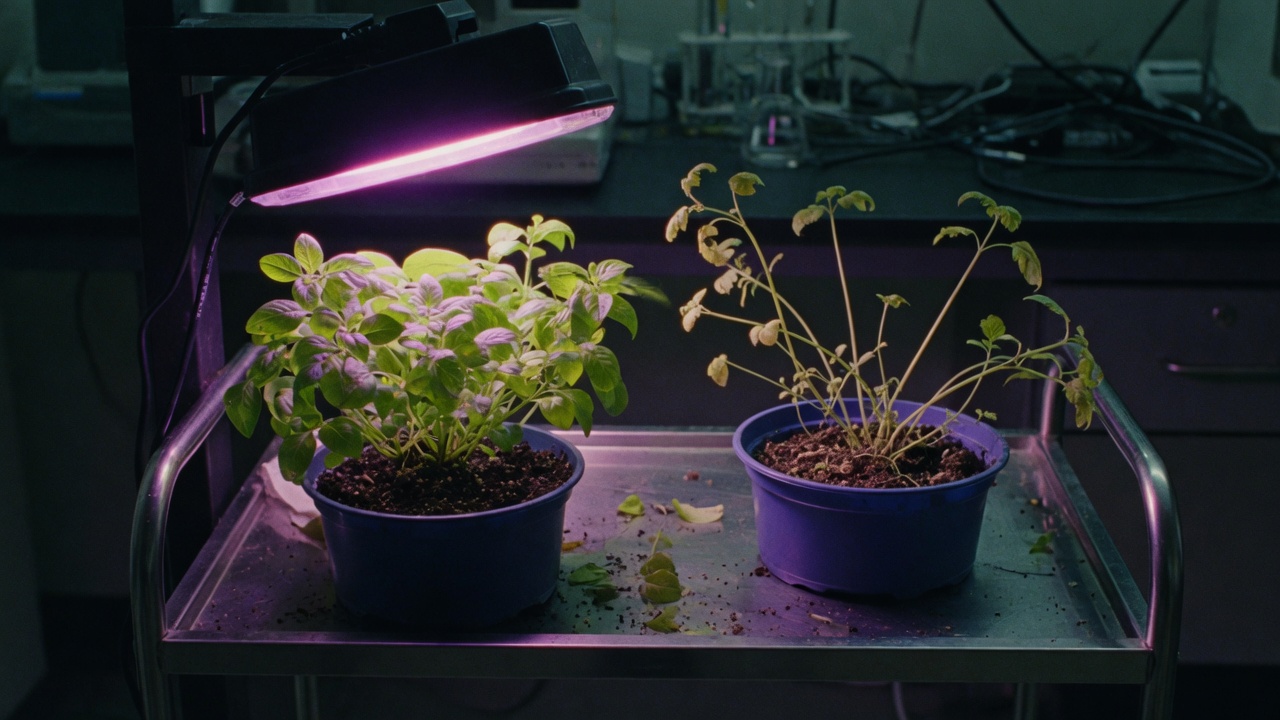
- Top image. Two potted plants growing under a lamp. It sets the scene for this lesson on behavior genetics and evolutionary psychology. Source: Created for this site with Grok Imagine (xAI), an AI image generator. License: Original image made for mattgaugerx.com.
- Tables. Figures 6.1 through 6.5 are HTML tables written for this page. Source: Created for this site. License: Original to mattgaugerx.com.
