is awareness of self and environment. Waking attention, daydreaming, sleep, a drug state, and are different conditions, even when ordinary speech piles them under one word. Sleep is an active, cycling state, not a blank, and sleep is a different suppression of awareness from general anesthesia. The word unconscious does not, by itself, name one procedure. This chapter separates the tracks of waking awareness, the architecture of a night of sleep, the main theories of dreaming, and the drug classes that change neural transmission (Myers & DeWall, 2021; Spielman et al., 2020).
5.1 Consciousness and the two tracks
Most of what the nervous system does never becomes a report the person can give. The heart keeps time, the eyes adjust to light, and a familiar route home can be followed while the person is busy with a conversation. Psychologists call this split . One track is conscious: relatively slow, sequential, and available to report. The other track is unconscious: fast, able to handle many streams at once, and outside the report. The two tracks run together. A person can deliberately steer a car and, at the same time, register the pressure of the seat and the drift of the lane without narrating either one (Myers & DeWall, 2021).
The conscious track has a narrow gate. is the focusing of awareness on one stimulus and the filtering of the rest. At a crowded party a person can follow one voice and let the other voices fall into noise, then switch when someone across the room says that person's name. The switch shows that the unattended stream was not erased. The unattended stream was held at a lower priority until a meaningful signal pulled the gate.
Selective attention has a cost, and the cost can be measured. is the failure to see a visible object because attention is occupied. In the best-known demonstration, viewers counted basketball passes in a short film. About half of the viewers did not report a person in a gorilla suit who walked through the middle of the scene and was visible for about nine seconds (Simons & Chabris, 1999). The gorilla was on the retina. The counting task had claimed the conscious track. Viewers who were counting the team whose shirts matched the gorilla's darkness noticed the gorilla more often, which shows that the filter follows what the task has defined as relevant.
A related failure is , the failure to notice that a scene has changed. In one field study a stranger asked a pedestrian for directions. During a brief interruption by a door carried between them, the stranger was replaced by a different person. A substantial share of pedestrians went on with the conversation and did not notice the switch (Simons & Levin, 1998). Inattentional blindness misses an unexpected object that was there. Change blindness misses a difference between one moment and the next. Both failures come from the same narrow gate. The visual system is not a video recorder that stores a complete scene for later inspection.
The separation of the two tracks is sharpest in . After damage to primary visual cortex, some people report no conscious sight in part of the visual field. Asked to guess the location or orientation of an object in that region, the same people perform above chance (Myers & DeWall, 2021). A response has been guided by visual information that did not become a visual experience. Blindsight is evidence that "the person saw it" and "the brain used visual information" are different claims. Figure 5.2 sets the three attention findings side by side.
| Finding | What is missed | What the task demanded |
|---|---|---|
| Inattentional blindness | A visible, unexpected object | Sustained counting of one stream |
| Change blindness | A replacement in the scene | An ongoing conversation, with a brief interruption |
| Blindsight | Conscious visual experience | A guess about location or orientation still uses the stimulus |
5.2 The circadian clock
Sleep is timed. A is a biological cycle of about 24 hours, and the sleep-wake cycle is the rhythm people notice first. Body temperature, hormone release, and alertness rise and fall on the same clock. Alertness commonly dips in the early afternoon and falls again through the evening, then returns as morning light arrives (Myers & DeWall, 2021; Spielman et al., 2020).
The clock sits in the , a pair of cell clusters in the hypothalamus, just above the optic chiasm. Light picked up by the retina reaches those cells and resets the day's timing. The suprachiasmatic nucleus then signals the pineal gland, which adjusts release of . Melatonin rises in the evening under dim light and promotes sleepiness. Morning light suppresses melatonin and shifts the clock toward the new day. Bright screens late at night delay that rise and push sleepiness later (Spielman et al., 2020).
When the light schedule jumps, the clock does not jump with the light schedule. After a flight across several time zones, the suprachiasmatic nucleus is still releasing its signals on the schedule of the city the traveler left. Sleepiness, hunger, and alertness arrive at the old hours until several days of light at the destination move the clock. Night-shift work creates the same mismatch from the other direction: the person is asked to be alert when melatonin is high and to sleep when daylight is telling the clock to wake. The mismatch is a property of the clock. The mismatch is not a failure of effort.
5.3 The stages of a night
The stages of sleep are defined by the , a recording of electrical activity from electrodes on the scalp, together with eye movements and muscle tone. An alert waking brain produces , fast and small. A relaxed waking brain, eyes closed, shifts toward , which are slower and more regular. Sleep itself divides into sleep and REM sleep. NREM, non-rapid-eye-movement sleep, includes the deeper stages. About every 90 minutes the sleeper passes through the NREM stages and a period of REM. That pass is one (Aserinsky & Kleitman, 1953; Myers & DeWall, 2021; Spielman et al., 2020).
NREM-1 is the entry. Breathing slows, and the EEG moves into . This stage lasts only a few minutes. A is common here: a brief feeling of falling, floating, or seeing a flash of light, sometimes followed by a sudden muscle twitch that jerks the person awake. The person may deny having been asleep. The EEG says otherwise.
NREM-2 occupies about half the night in a healthy adult. The sleeper is clearly asleep and can still be awakened without great difficulty. Two EEG marks define the stage. A is a short burst of rapid, rhythmic activity. A is a single high-amplitude spike, often after a sudden sound. The K-complex is one way the sleeping brain answers the outside world without waking (Spielman et al., 2020).
NREM-3 is deep sleep, also called slow-wave sleep. The EEG fills with , which are large and slow. The sleeper is hard to awaken. Heart rate and breathing are at their slowest. Children spend more of the night here than older adults do, and the pituitary releases growth hormone during this stage. Night terrors, sleepwalking, and sleep talking, when they occur, occur here, and they occur mostly in the first half of the night, when NREM-3 is longest (Myers & DeWall, 2021).
sleep, rapid-eye-movement sleep, usually begins about 90 minutes after sleep onset. The eyes dart under the lids. Heart rate rises, and breathing becomes faster and irregular. The EEG looks faster and more wake-like, closer to beta activity than to the slow waves of deep NREM. Vivid dreaming is common. The genitals become aroused whether or not the dream is sexual, so arousal during REM is a feature of the stage, not a reading of the dream's plot. Motor cortex is active, but the brainstem blocks most of the messages to the skeletal muscles, and the body is largely still. Because the brain is active while the body is paralyzed, REM is also called (Aserinsky & Kleitman, 1953; Myers & DeWall, 2021).
The shape of the night changes from cycle to cycle. In the first cycles, NREM-3 is long and REM is short. Toward morning, NREM-3 nearly disappears and REM periods lengthen, sometimes toward the better part of an hour. A person who sleeps only five hours still gets much of the night's deep NREM and loses a large share of REM. A person who sleeps nine hours spends much of the extra time in REM and in NREM-2. Figure 5.1 compares the stages. Figure 5.3 compares the early night with the late night.
| Stage | Brain and body | Experience |
|---|---|---|
| Awake, alert | Beta waves; muscle tone present | Reportable awareness |
| Awake, relaxed | Alpha waves | Calm, eyes often closed |
| NREM-1 | Theta waves; easy to wake | Hypnagogic images; a sudden twitch |
| NREM-2 | Sleep spindles and K-complexes | Clearly asleep; about half the night |
| NREM-3 | Delta waves: slower, larger than REM | Deep sleep; hard to wake; more common early |
| REM | Faster, more wake-like EEG; eyes move; body largely still | Vivid dreaming is common |
| First half of the night | Second half of the night | |
|---|---|---|
| NREM-3 | Long stretches of delta sleep | Little or none |
| REM | Short periods | Longer periods |
| If sleep is cut to five hours | Much of the deep NREM is kept | A large share of REM is lost |
5.4 What sleep is for, and when sleep fails
No single function explains all of sleep. Several functions have evidence behind them, and a night of sleep can serve more than one (Myers & DeWall, 2021). One function is protection. A diurnal animal that is quiet and out of sight during the dark hours meets fewer predators and fewer falls. The urge to sleep tracks the hours when vision is poor. A second function is restoration. Sleep supports the immune system and gives the brain time for housekeeping, including the clearance of metabolic waste that accumulates during waking. A third function is the stabilization of some new learning. People who sleep after learning a visual skill or a list of new material often hold that material more steadily than people who spend the same hours awake. The claim is about some kinds of learning across a delay. The claim is not that every experience is replayed as a story. A fourth function is flexibility of thought. After sleep, people more often see a new arrangement of a problem they were stuck on. A fifth function is growth. During deep NREM the pituitary releases growth hormone, which is one reason infants and children, who are growing fastest, spend so much of the night in NREM-3.
Cut the night short, and those functions fray in ways a laboratory can measure. Attention wanders, reaction time slows, and irritability rises. Microsleeps, brief lapses into sleep, intrude into waking and are one reason drowsy driving is dangerous. Hunger hormones shift toward greater appetite, and studies link chronic short sleep with weight gain. Immune responses to a challenge are weaker after sleep loss. The effects add across nights. A person who sleeps six hours and feels "used to it" can still show slowed reactions on a vigilance task (Myers & DeWall, 2021; Spielman et al., 2020).
is ongoing trouble falling asleep or staying asleep, with daytime cost. Occasional bad nights are ordinary. Insomnia is the pattern that persists. Worry about the sleeplessness, irregular hours, late caffeine, and alcohol that fragments the second half of the night all make the pattern worse. Sleeping pills can induce sleep and, with continued use, reduce REM and produce tolerance, so the same dose does less. The more durable treatments change the conditions and the habits around the bed: a stable wake time, a dark and cool room, and a rule that the bed is for sleep rather than for hours of frustrated waking (Spielman et al., 2020).
is a disorder of sudden sleep attacks. The person may move from waking straight into REM, which is why the attack can include dreamlike images and a loss of muscle tone. Many cases involve the loss of , also called hypocretin, a hypothalamic neurotransmitter that helps keep the person awake. Some people with narcolepsy also have , a sudden loss of muscle tone during waking, often set off by laughter or another strong emotion. Cataplexy is the REM atonia system intruding into the day. The person may remain awake while the body goes slack (Myers & DeWall, 2021).
is a disorder in which breathing repeatedly stops during sleep. Each stop can last long enough to drop blood oxygen and force a brief awakening, often with a snort, and the awakenings may number in the hundreds across a night. The sleeper usually does not remember the awakenings and instead reports loud snoring and severe daytime sleepiness. Excess weight raises the risk because tissue can narrow the airway, and apnea also occurs in people who are not overweight. A mask that keeps the airway open with gentle air pressure, continuous positive airway pressure, is a common treatment (Spielman et al., 2020).
Two frightening events in childhood sleep are easy to mix up, and the stages separate them. A strikes during NREM-3, usually in the first hours of sleep. The child may sit up, shout, and look terrified, with a racing heart, and then fall back asleep. In the morning the episode is remembered poorly or not at all. A nightmare is a REM dream, more often toward morning, and the dreamer can usually tell the story. is also an NREM-3 behavior: walking or other complex movement, usually with no memory of the episode, and usually in children, who are outgrowing the long stretches of delta sleep. A sleepwalker can be guided back to bed. Waking the person is not harmful, though the person may be briefly confused. Acting out a dream, with speech and movement during REM, is a different disorder, seen more in older adults, in which the brainstem fails to keep the muscles still. Figure 5.4 holds these distinctions in one place.
| Disorder | When | What people confuse with this disorder |
|---|---|---|
| Insomnia | Trouble falling or staying asleep, with daytime cost | An occasional short night |
| Narcolepsy | Sudden sleep, sometimes straight into REM; orexin is often low | Ordinary tiredness |
| Sleep apnea | Breathing stops; brief awakenings all night | Simple snoring with a rested day |
| Night terror | NREM-3, early night; little memory | A nightmare, which is a remembered REM dream |
| Sleepwalking | NREM-3 movement; usually no memory | Acting out a dream during REM |
5.5 Dreams
Dreams occur in every stage. The dreams people tell as stories, with places, perception, and emotion, come mostly from REM. NREM dreams are more often a thought, a fragment, or a static scene. Wake a person from REM and a report of a dream is likely. Wake the same person from NREM-3 and a report is less likely and less pictorial (Myers & DeWall, 2021).
Sigmund Freud treated the dream as a disguised wish. In that theory the is the storyline the dreamer can tell, and the is a hidden meaning, censored into symbols. The distinction is historically important. The distinction is not a method that has held up. There is no reliable procedure that takes a manifest story and recovers a unique latent meaning. Two interpreters can assign two meanings, and nothing in the method decides between the two meanings (Myers & DeWall, 2021).
Later theories stay closer to what a sleep lab can measure. One proposal is informational. Across the day the brain takes in more than the brain can finish sorting, and REM may help stabilize some of that material and discard the rest. The proposal fits the finding that sleep after learning often protects the learning. The proposal does not require the dream story to be a coded message about the learning. A second account is physiological. says that during REM the brainstem bombards the cortex with relatively random activation, and the cortex synthesizes a story in order to make sense of the activation (Hobson & McCarley, 1977). On this view the plot is the brain's best guess, the way a person finds a shape in a cloud. The limbic system is active, which fits the emotional tone of many dreams, and the frontal regions that ordinarily plan and inhibit are relatively quiet, which fits the odd jumps in logic. A third account is cognitive. Dreams are a form of thinking, and the complexity of dreams tracks the dreamer's cognitive development. A young child's dream reports are simpler than an adult's because the child's conceptual world is simpler. These three accounts can all be partly right: the brainstem may supply activation, the day's learning may bias which traces are active, and the cortex may build the best story the cortex can build.
Deprive a person of REM, by waking the person at the start of each REM period, and the pressure for REM rises. On a later free night, REM increases. That increase is . Alcohol and some sleeping medications suppress REM. When the suppression lifts, REM rebound can bring intense, busy dreams. The rebound is one reason a theory of dreaming has to explain not only the story but the pressure to enter the state (Myers & DeWall, 2021).
5.6 Psychoactive drugs
A is a chemical that alters perception, mood, or consciousness by acting on neural transmission. The effect is an effect at synapses. The effect is not a mood that arrives without a mechanism. The neuron lesson already set the vocabulary. This section uses that vocabulary on the three classes an introductory course has to be able to tell apart: depressants, stimulants, and hallucinogens (Myers & DeWall, 2021; Spielman et al., 2020).
Repeated use changes both behavior and the synapse. A is continued use despite significant disruption of life: control slips, use continues in hazardous situations, work or relationships give way, and the body may show tolerance and withdrawal. is a reduced effect at the same dose, so a larger dose is required for the original effect. The nervous system has adapted, a process called neuroadaptation. is the discomfort and distress that follow stopping the drug. Withdrawal often looks like the opposite of the drug's effect, because the adaptations are suddenly unopposed. Craving can remain after the bodily withdrawal has faded. Modern diagnosis gathers these patterns under substance use disorder rather than treating "addiction" as a single all-or-none label (Spielman et al., 2020).
At the receptor, two relations matter. An mimics a neurotransmitter at that neurotransmitter's receptor and increases the signal. An sits on the receptor without activating the receptor, and blocks the neurotransmitter. A third trick, already met with the SSRIs, is to slow reuptake so the neurotransmitter lingers in the cleft. Cocaine, amphetamines, and some of the drugs below use one or more of these three moves.
A calms neural activity and slows body functions. Alcohol is the depressant people know best. Alcohol increases the inhibitory action of , the main inhibitory neurotransmitter, and alcohol reduces the excitatory action of . Judgment and inhibition loosen first, which is why a low dose can feel like stimulation even though the drug is slowing the nervous system. Speech slurs, balance fails, and reaction time lengthens as the dose rises. Memory formation is disrupted, and a blackout is a gap in memory, not a gap in having been awake and active. Alcohol also suppresses REM. Expectancy matters on top of the chemistry: people who believe a drink contains alcohol will often behave more loosely even when the drink does not. Combined with another depressant, alcohol's slowing of breathing can be fatal (Myers & DeWall, 2021).
, sometimes prescribed to induce sleep or reduce anxiety, are depressants of the same broad family. A barbiturate plus alcohol is a classic lethal pair, because both slow the systems that keep breathing going. , including opium, morphine, heroin, and similar painkillers, are also depressants. Opiates lessen pain and anxiety and slow breathing. They are agonists at receptors for , the body's own pain-relieving neurotransmitters. With repeated use the brain produces fewer endorphins of its own. Stopping the drug then leaves pain and distress unbuffered, which is a large part of opioid withdrawal: agitation, cramps, and chills, while the missing endorphin signal returns only slowly. Pupils constrict, and an overdose can stop breathing. Naloxone is an opioid antagonist used in emergencies because naloxone occupies the same receptors and can restore breathing. Naloxone is a clean classroom example of an antagonist, and naloxone is not a treatment plan for substance use disorder by itself (Spielman et al., 2020).
A excites neural activity and speeds body functions. Pupils dilate, heart rate and breathing rise, appetite falls, and energy and confidence rise, often followed by a crash. Caffeine is a mild stimulant and an antagonist at receptors for , a neuromodulator that builds the pressure to sleep across a day of waking. Blocking adenosine delays sleepiness. Late caffeine therefore fights the circadian evening and can fragment sleep. Stopping a daily caffeine habit produces a withdrawal headache and fatigue. Nicotine is a faster stimulant. Within seconds of inhalation, nicotine acts on acetylcholine receptors and triggers a release of epinephrine, norepinephrine, and dopamine. Heart rate rises, and the dopamine signal is a large part of why nicotine is so hard to stop. Withdrawal brings craving, anxiety, irritability, and troubled sleep. Tolerance develops, so the same cigarette does less, and the person smokes to escape withdrawal as much as to gain pleasure (Myers & DeWall, 2021).
Cocaine is a stronger stimulant with a short course. Cocaine blocks of dopamine, norepinephrine, and serotonin, so those transmitters stay in the cleft and keep stimulating the receiving neuron. The rush of energy and euphoria is followed, within a fairly short time, by a crash into agitation and a low mood, which invites another dose. Cardiac arrest and stroke are among the risks, because the same chemistry that speeds mood also speeds the heart and constricts blood vessels. An elevates mood and speeds the body by increasing dopamine release and slowing dopamine reuptake. Methamphetamine is a more potent member of that family, with a longer course. Heavy use has been associated with a fall in baseline dopamine function, which fits the fatigue and low mood that follow a binge. Ecstasy, or MDMA, is a stimulant and a mild hallucinogen. MDMA releases serotonin and blocks serotonin reuptake. Users report warmth and a heightened sense of connection, along with dehydration and, in a hot crowded setting, a dangerous rise in body temperature. Repeated heavy use has been associated with damage to serotonin-producing neurons (Myers & DeWall, 2021).
A distorts perception and evokes sensory images without a matching sensory input. LSD acts at serotonin receptors. Emotion under LSD can swing from euphoria to panic in the same session, and the hallucinations can include geometric patterns, intensified color, and a changed sense of the body. Some users later report brief perceptual flashbacks. Marijuana's main psychoactive chemical, THC, binds cannabinoid receptors. The usual effects are relaxation, a loosened inhibition, an altered sense of time, and mild hallucination at higher doses. THC also impairs coordination, reaction time, and the formation of memories during the intoxication. Because THC is stored in body fat, THC can remain detectable for days or longer, and a regular user may carry a lingering dose into the next day. Marijuana has medical uses, including treatment of nausea and some kinds of pain. Those uses do not cancel the effects on attention and memory during intoxication. Figure 5.5 sorts the three classes by what they do at the synapse and to behavior.
| Class | Examples | What changes |
|---|---|---|
| Depressant | Alcohol, barbiturates, opiates | Neural activity and body functions slow. Alcohol increases GABA inhibition and reduces glutamate excitation. Opiates mimic endorphins. |
| Stimulant | Caffeine, nicotine, cocaine, amphetamines, MDMA | Neural activity and body functions speed up. Caffeine blocks adenosine. Cocaine blocks reuptake of dopamine. |
| Hallucinogen | LSD, marijuana (THC) | Perception is distorted. LSD acts at serotonin receptors. THC acts at cannabinoid receptors. |
5.7 Hypnosis and trained attention
is a social interaction in which one person suggests to another that certain perceptions, feelings, or behaviors will occur. The procedure usually includes a quiet induction, a narrowing of attention, and a series of suggestions. People differ in how far the suggestions go. Hypnosis can reduce felt pain in many responsive people, which is why hypnotic analgesia has a place in some medical and dental procedures. Hypnosis does not give the hypnotist ownership of the person's will. A person can refuse a suggestion, especially a suggestion that violates a strong value. Stage acts that look like total control are a poor guide to the laboratory findings (Myers & DeWall, 2021).
Two popular claims fail. Age regression does not return the person to a literal earlier age with a child's actual capacities. Memory recovery under hypnosis does not open a sealed recording of the past. Suggestion can add details the person later feels certain about, so a memory produced under hypnosis is not reliable evidence. The risk is a confident false memory, not a unlocked file (Myers & DeWall, 2021).
Two theories divide the field. The social-influence account says the hypnotized person is playing a role, caught up in the expectations of a good subject, the way an absorbed actor feels a scene without forgetting the stage. The account fits the way hypnotic behavior tracks what the person believes hypnosis is supposed to look like. The dissociation account says hypnosis produces a , a split in consciousness that lets some thoughts and behaviors occur apart from awareness. Ernest Hilgard's cold-pressor studies are the classic illustration: a hypnotized person reports little pain with a hand in ice water, while a second, "hidden observer" report, given under a prearranged cue, describes the pain. Dual processing makes room for both accounts. Expectation and role can shape the conscious track, and a split can leave a parallel report that the conscious track is not giving (Myers & DeWall, 2021).
Meditation belongs with the same question of what awareness can be trained to do. In this chapter, meditation means training of attention. is paying attention to present experience on purpose, without trying to judge the experience. A focused-attention practice instead holds one object, often the breath, and returns to that object when attention leaves. Laboratory and clinical studies associate regular practice with lower reported anxiety and with changes in how attention is directed. The studies do not make meditation a treatment for the sleep disorders or the substance use disorders above. The studies do show that the conscious track is a skill with a measurable range, not a fixed lamp (Spielman et al., 2020).
| Claim about hypnosis | What the evidence supports |
|---|---|
| Felt pain can be reduced | Yes, in many responsive people |
| The person must obey any command | No. The person can refuse |
| Age regression restores an earlier age | No. The behavior is adult behavior under a suggestion |
| Buried memories return accurately | No. Suggestion can add false memories |
Taken together, the chapter is a map of states, not a single switch called consciousness. Selective attention shows how narrow the reportable track is. The circadian clock and the EEG stages show that sleep is organized, cycling, and unlike anesthesia. Dreams have a physiology, and the story a dream tells is not, by itself, a decoded message. Psychoactive drugs change those states by agonists, antagonists, and reuptake block at particular synapses, and the body adapts, which is what tolerance and withdrawal record. The next lesson leaves the states of one nervous system and asks how genes and environment contribute to differences among people.
Check yourself
A viewer counting passes misses a person in a gorilla suit who was on screen for several seconds. Which failure is that, and which failure would a swapped conversation partner illustrate instead?
Missing the gorilla is inattentional blindness: a visible object is not reported because attention is on the counting task (Simons & Chabris, 1999). Failing to notice that one conversation partner was replaced by another is change blindness (Simons & Levin, 1998).
Which EEG marks define NREM-2, and how do deep NREM and REM differ on the EEG?
Sleep spindles and K-complexes define NREM-2. Deep NREM-3 shows delta waves, which are slower and larger. REM is faster and more wake-like. Figure 5.1 sets the comparison out.
A child sits up shouting in the first hours of sleep and remembers nothing in the morning. Why is that episode not a nightmare?
The episode is a night terror, which occurs in NREM-3 and is remembered poorly or not at all. A nightmare is a REM dream, more often later in the night, and the dreamer can usually report the story.
Why does activation-synthesis theory refuse to treat a dream plot as a coded message?
On that theory the brainstem supplies relatively random activation during REM, and the cortex builds a story to make sense of the activation (Hobson & McCarley, 1977). The plot is the synthesis. The plot is not a separate latent text.
Alcohol feels stimulating at a low dose. Why does the lesson still class alcohol as a depressant?
Alcohol increases GABA's inhibitory action and reduces glutamate's excitatory action, so neural activity slows. The early feeling of stimulation comes from the loosening of judgment and inhibition, which is itself a slowing of the systems that normally restrain behavior.
A person needs a larger dose to get the effect that a smaller dose used to give. What has developed, and what is withdrawal?
Tolerance has developed: the same dose now does less, because the nervous system has adapted. Withdrawal is the discomfort and distress that follow when the drug is stopped and those adaptations are unopposed.
Check yourself with a quick quiz
A few questions on this lesson only. Questions you miss come back later. Progress stays in this browser and is shared with the full quiz.
References
- Aserinsky, E., & Kleitman, N. (1953). Regularly occurring periods of eye motility, and concomitant phenomena, during sleep. Science, 118(3062), 273–274.
- Hobson, J. A., & McCarley, R. W. (1977). The brain as a dream state generator: An activation-synthesis hypothesis of the dream process. American Journal of Psychiatry, 134(12), 1335–1348.
- Myers, D. G., & DeWall, C. N. (2021). Psychology (13th ed.). Worth.
- Simons, D. J., & Chabris, C. F. (1999). Gorillas in our midst: Sustained inattentional blindness for dynamic events. Perception, 28(9), 1059–1074.
- Simons, D. J., & Levin, D. T. (1998). Failure to detect changes to people during a real-world interaction. Psychonomic Bulletin & Review, 5(4), 644–649.
- Spielman, R. M., Jenkins, W. J., & Lovett, M. D. (2020). Psychology 2e. OpenStax. Chapter 4, States of consciousness. https://openstax.org/books/psychology-2e/pages/4-introduction
Image and media credits
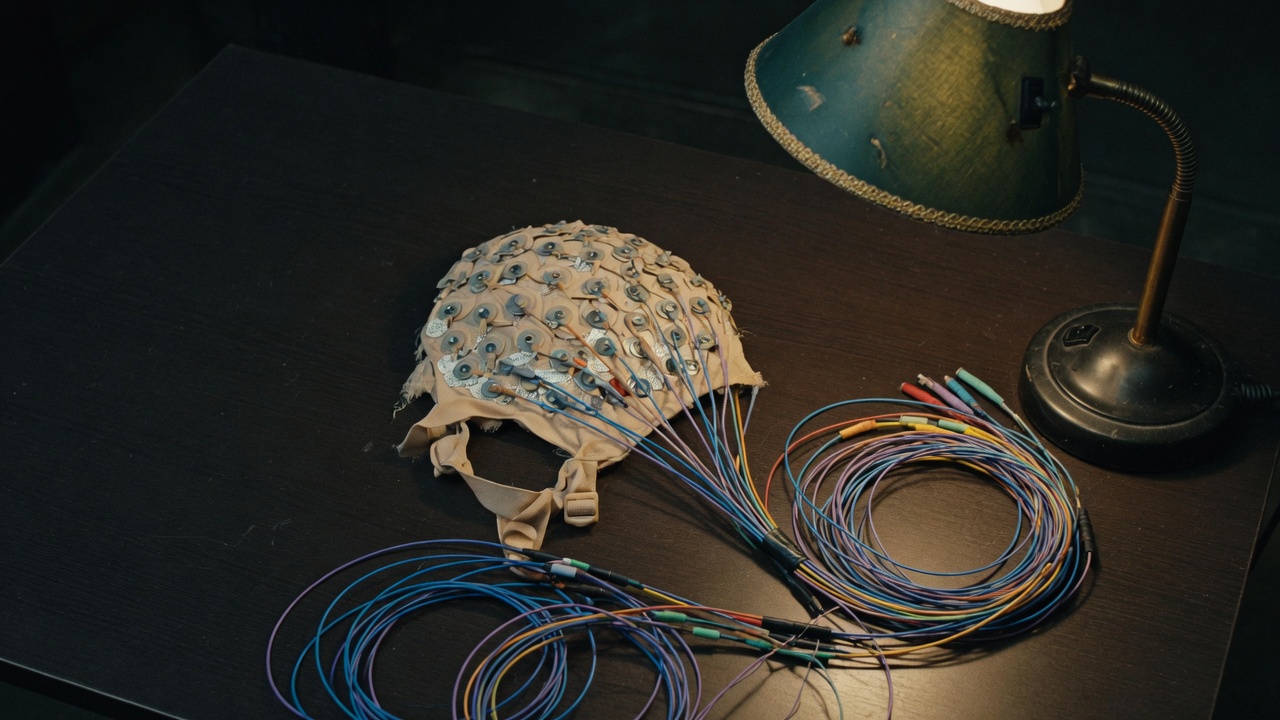
- Top image. A sleep-lab EEG cap and its wires on a desk at night. It sets the scene for this lesson on consciousness, sleep, and psychoactive drugs. Source: Created for this site with Grok Imagine (xAI), an AI image generator. License: Original image made for mattgaugerx.com.
- Tables. Figures 5.1 through 5.6 are HTML tables written for this page. Source: Created for this site. License: Original to mattgaugerx.com.
