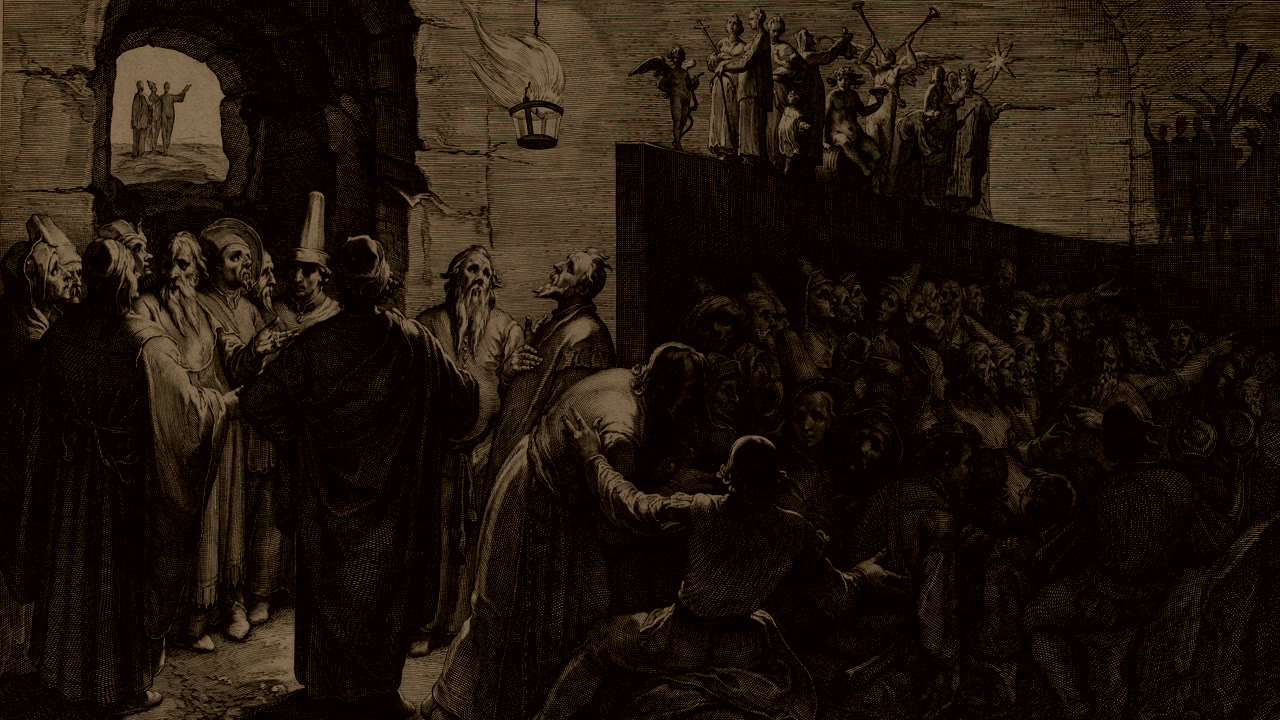
Is the world you see with your eyes the most real thing there is?
Plato said no, and he spent his life arguing for that answer. Plato (about 428 to 348 BC) was an Athenian aristocrat who, as a young man, watched his teacher Socrates questioned, tried, and executed. He founded the in Athens around 387 BC, a school that lasted in one form or another for centuries, and he wrote about thirty-five dialogues. In his early dialogues Socrates mostly asks questions, as Lesson 1 showed. In the middle dialogues, especially the Republic, Socrates becomes the voice for Plato's own large theories (Kraut, 2022).
Those theories shaped so much of later thought that the philosopher Alfred North Whitehead called the European philosophical tradition "a series of footnotes to Plato" (Whitehead, 1929/1978, p. 39). This lesson covers the three most famous: the Forms, the Cave, and the soul.
In one minute
- Plato asked what Socrates' definitions are about, if everything we see keeps changing.
- His answer: the Forms, perfect and unchanging realities known by reason, not by the senses.
- The Divided Line ranks four kinds of thinking, from guessing about shadows to understanding the Forms.
- The Allegory of the Cave pictures education as turning the whole soul from shadows toward the light.
- The soul has three parts, reason, spirit, and appetite; justice is each part doing its own work.
- Critics, starting with Plato himself and his student Aristotle, pressed hard objections.
The problem
If everything around you is always changing, what is a definition about?
Lesson 1 met two thinkers who disagreed about change. Heraclitus said everything is always changing; Parmenides said real change is impossible. Socrates then spent his life asking for definitions: not this brave act or that fair deal, but courage itself and justice itself. Plato put those threads together. Every brave act we see is mixed, partial, and passing. A definition of courage, if one exists, has to be about something that does not change from case to case.
So there seem to be two kinds of thing. The objects of the senses come into being, change, and pass away; Plato called them the world of . What a true definition describes is stable and the same for everyone; Plato called it .
The Forms
Why can a geometry teacher prove things about a perfect circle that no one has ever drawn?
Because the proof is not about the chalk. Every drawn circle is a little lopsided, yet the theorem about circles is exactly true. Plato concluded that the theorem is about the circle itself, which the mind grasps and the eye never sees. He called such realities (the Greek words are eidos and idea, but a Form is not an idea in anyone's head).
According to the , there is a Form for Circle, Equality, Justice, Beauty, and many other things. Each Form is perfect, unchanging, and non-physical. Particular things are what they are because they in a Form: a coin is round by sharing, imperfectly, in Circle. In the Phaedo, Socrates notes that two sticks can look equal from one angle and unequal from another, yet Equality itself never looks unequal; so knowing what equality is cannot come from the sticks alone (Plato, 2002, Phaedo 74a-c). Figure 3.1 shows the picture.
The Divided Line
Is "knowing" one thing, or are there levels of it?
Plato thought there were levels, and in the Republic he drew them as a line cut into four unequal parts, the (Plato, 1992, Republic 509d-511e). The lower half is the visible world, where the best we can have is (doxa). The upper half is the intelligible world, where real (episteme) is possible. Figure 3.2 lays out the four parts, from the bottom up:
- Imagining: taking shadows, reflections, and images at face value.
- Belief: trusting ordinary physical things as the way the world is.
- Thought: reasoning about mathematical objects from starting assumptions, using drawings as aids.
- Understanding: grasping the Forms themselves, without images, all the way up to the Form of the Good.
The sits at the very top. Plato compares it to the sun: as the sun makes things visible and lets them grow, the Good makes the Forms knowable and gives them their being (Republic 507b-509b).
The Cave
What if everything you have ever seen were only a shadow of something more real?
Plato turns the Divided Line into a story, the , the most famous image in philosophy (Republic 514a-520a). It opens like this:
"Behold! human beings living in a underground den, which has a mouth open towards the light and reaching all along the den; here they have been from their childhood, and have their legs and necks chained so that they cannot move, and can only see before them." Plato, Republic VII 514a (Jowett translation)
Behind the prisoners a fire burns. Between the fire and the prisoners runs a low wall, and people walk behind it carrying objects on poles, like puppeteers. The prisoners see only the shadows those objects throw on the cave wall, and they take the shadows to be the whole of reality. Figure 3.3 shows the layout.
Now one prisoner is freed and turned around. The fire hurts his eyes; at first the shadows seem more real than the objects that cast them. He is dragged up the steep way out. Outside, dazzled, he can look only at shadows and reflections, then at the things themselves, then at the night sky, and at last at the sun, which he understands is the cause of the seasons and of everything he used to see. Then he goes back down to free the others. His eyes, now used to daylight, cannot make out the shadows, and the prisoners laugh at him. Plato adds a line that every reader of the time would connect with Socrates: if anyone tried to lead them up, "let them only catch the offender, and they would put him to death" (Republic 517a, Jowett translation).
Plato tells us how to read the story: the cave is the visible world, the fire is the sun, and the journey upward is "the ascent of the soul into the intellectual world" (Republic 517b, Jowett translation). Each stage of the climb matches a segment of the Divided Line, as Figure 3.4 shows.
| Stage in the cave story | Segment of the line | What it means |
|---|---|---|
| Watching shadows on the wall | Imagining | Accepting images and appearances without question |
| Turning to see the objects and the fire | Belief | Trusting ordinary physical things |
| Outside: shadows and reflections of real things | Thought | Reasoning with the help of images and assumptions, as in geometry |
| Outside: the things themselves, then the sun | Understanding | Grasping the Forms and, finally, the Good |
What education is
If learning is not pouring facts into an empty head, what is it?
Plato's answer is one of the most quoted ideas in the history of education. Teachers who claim to put knowledge into a soul, he says, are like someone claiming to put sight into blind eyes. The ability to learn is already there; the work is to turn it the right way:
"The power and capacity of learning exists in the soul already; and ... just as the eye was unable to turn from darkness to light without the whole body, so too the instrument of knowledge can only by the movement of the whole soul be turned from the world of becoming into that of being." Plato, Republic VII 518c (Jowett translation)
Two points follow. Education is a turning of the whole person, habits and desires included, not just the intellect. And the person who has seen more has a duty to go back down: Plato insists that the freed prisoner must return to help those still in the cave, even though the trip is thankless.
Plato backs the idea with an argument in the Meno. Socrates questions an enslaved boy who has never studied geometry and, by questions alone, leads him to find the square with twice the area of a given square. Socrates claims he taught nothing; the boy recollected it. Plato concludes that learning is (anamnesis) of what the soul knew before birth (Plato, 2002, Meno 82b-86b).
The soul
Have you ever wanted something and, at the same moment, been disgusted with yourself for wanting it?
Plato used exactly that experience to argue that the soul has parts. In Republic IV he tells the story of Leontius, who saw corpses lying by the city wall, wanted to look, felt disgust at the wish, covered his eyes, and finally ran to them, shouting at his own eyes, "Look, ye wretches, take your fill of the fair sight" (Republic 439e-440a, Jowett translation). Something in Leontius wanted, and something else in him was angry at the wanting.
Plato's has three parts. loves truth and works out what is best for the whole person. is the source of anger, pride, and the sense of honor; it can side with reason, as when we are indignant at our own weakness. wants food, drink, sex, and money. A person, in Plato's sense, is one in whom each part does its own work: reason rules, spirit backs reason up, and appetite is kept in proportion (Republic 441d-442b). Plato's ideal city in the Republic has the same three-part structure, shown in Figure 3.5.
Test the argument
Plato's case for a divided soul is an argument. Does it hold up?
Lesson 2's tools apply directly. Plato's key premise is the : "The same thing clearly cannot act or be acted upon in the same part or in relation to the same thing at the same time, in contrary ways" (Republic 436b, Jowett translation). His example is a thirsty person who refuses to drink, perhaps knowing the water is bad. Figure 3.6 puts the argument in standard form.
Objections
If Plato was right, why did his best student reject the Forms?
Because the theory raises hard questions, and Plato knew it. In his own dialogue the Parmenides, an elderly Parmenides presses young Socrates with what later readers call the : if large things are large because they share in the Form of Largeness, then the large things and Largeness itself seem to share something further, a second Form of Largeness, and so on without end (Plato, Parmenides 132a-b). If that regress cannot be stopped, the Forms explain nothing.
Aristotle, who studied at the Academy for twenty years, objected that Forms existing apart from things cannot explain how things change or what they are; "participation," he said, is only an empty word (Aristotle, Metaphysics I.9). Lesson 4 follows Aristotle's alternative, which places form inside things. Even so, Plato's conviction that the visible world is not the whole of reality, and that truth and goodness are found rather than invented, runs through the rest of this course, including Augustine in Lesson 5.
Skills to keep
What can you take from Plato into an ordinary week?
- Ask what the image is an image of. A photo, a clip, or a headline is a shadow on the wall; look for the thing that cast it.
- Expect disorientation. When a better explanation first hurts your eyes, that is often a sign of learning, not of error.
- Notice your inner conflict. When you want two opposite things, ask which part of you is speaking, and which should rule.
- Go back down. Understanding something is a reason to help others see it, patiently, without mocking anyone still in the cave.
Try it: five minutes
Write down one belief you once held firmly and later found was only a shadow: a first impression of a person, a rumor, a confident claim you read online. Then answer three questions in a sentence each. What was the "fire" that cast the shadow? What turned you around? Which segment of the Divided Line were you on before, and which are you on now?
Check yourself
Check yourself
What problem were the Forms meant to solve?
If everything we sense keeps changing, Socrates' definitions need something stable to be about. The Forms are those unchanging realities.
Name three features of a Form.
Perfect, unchanging, and non-physical; known by reason rather than the senses.
What does it mean for a coin to "participate" in the Form of Circle?
The coin is round by imperfectly sharing in Circle itself; its roundness depends on the Form.
List the four segments of the Divided Line from bottom to top.
Imagining, belief, thought, understanding.
In the Allegory of the Cave, what do the shadows and the sun stand for?
The shadows are appearances taken at face value; the sun is the Form of the Good.
According to Plato, why is putting knowledge into a soul impossible?
The capacity to learn is already in the soul; education turns the whole soul toward the truth, as the whole body must turn for the eye to see the light.
Name the three parts of the soul and the virtue of each.
Reason (wisdom), spirit (courage), appetite (moderation, which is really agreement among all three).
State the Third Man argument in one sentence.
If large things share in Largeness because they have something in common, then they and Largeness share a further Form, and so on without end.
Check yourself with a quick quiz
A few questions on this lesson only. Questions you miss come back later. Progress stays in this browser and is shared with the full quiz.
Top image: Jan Saenredam after Cornelis van Haarlem, Plato's Cave, engraving, 1604, National Gallery of Art, Washington. CC0 (public domain).
References
- Aristotle. (1984). Metaphysics (W. D. Ross, Trans.). In J. Barnes (Ed.), The complete works of Aristotle (Vol. 2). Princeton University Press.
- Kenny, A. (2010). A new history of Western philosophy. Oxford University Press.
- Kraut, R. (2022). Plato. In E. N. Zalta & U. Nodelman (Eds.), The Stanford encyclopedia of philosophy. https://plato.stanford.edu/entries/plato/
- Plato. (1992). Republic (G. M. A. Grube, Trans.; C. D. C. Reeve, Rev.). Hackett. Cited by Stephanus numbers.
- Plato. (n.d.). The republic (B. Jowett, Trans.). Project Gutenberg. Source of the quoted passages. https://www.gutenberg.org/ebooks/1497
- Plato. (2002). Five dialogues: Euthyphro, Apology, Crito, Meno, Phaedo (G. M. A. Grube, Trans.; J. M. Cooper, Rev.; 2nd ed.). Hackett.
- Plato. (1997). Parmenides (M. L. Gill & P. Ryan, Trans.). In J. M. Cooper (Ed.), Plato: Complete works. Hackett.
- Saenredam, J., after Cornelis van Haarlem. (1604). Plato's cave [Engraving]. National Gallery of Art, Washington. CC0. Page image cropped (inscriptions removed) and darkened. Wikimedia Commons
- Whitehead, A. N. (1978). Process and reality (Corrected ed.). Free Press. (Original work published 1929)

