If someone asked you why you believe what you believe, could your reason survive a second question?
Most of us hold our biggest beliefs, about what is real, what is right, and what a life is for, without ever having tested them. is the discipline that tests them. The word comes from the Greek philosophia, "love of wisdom." In practice, philosophy is careful reasoning about the most basic questions, done by giving an : reasons laid out so that anyone can check whether the conclusion really follows (Perry et al., 2016).
This first lesson follows the person most responsible for turning that love of wisdom into a way of life: Socrates of Athens, a man who wrote nothing, questioned everyone, and was put to death for it in 399 BC.
In one minute
- Philosophy tests basic beliefs with arguments anyone can inspect.
- It began in Greece when thinkers like Thales traded myth for reasons.
- Socrates claimed only one kind of wisdom: he knew what he did not know.
- His method: ask for a definition, test it with a counterexample, revise.
- The Euthyphro shows the method at work and leaves a dilemma still argued today.
- Athens executed him. His last defense: the unexamined life is not worth living.
The map
If science can measure almost anything, what questions are left for philosophy?
The questions that measurement alone cannot answer. A lab can tell you how much of their memory people retain after a short night of sleep. The lab cannot tell you, by measuring, what counts as good evidence in the first place, whether you ought to keep a promise that costs you, or whether anything exists beyond the physical world. Those questions sit underneath every other field, including science itself.
Philosophers sort those questions into branches. asks what is real. asks what knowledge is and how a person gets it. studies which conclusions follow from which reasons. asks how a person should live and act. Figure 1.1 places those four beside political philosophy, aesthetics, and the philosophy of religion. Each later lesson in this course lives mostly in one or two of those branches.
Where it began
Why did people start doing philosophy in Greece around 600 BC, instead of just telling the old stories?
Because a few thinkers began asking for explanations that anyone could examine. The Greek poets Homer and Hesiod explained storms and seasons through the moods of the gods. Around 585 BC, of Miletus, a trading city on the coast of what is now Turkey, proposed instead that everything is ultimately made of water, and ancient writers credit him with predicting a solar eclipse (O'Grady, n.d.). The water answer is wrong. The move behind the water answer was new: a claim about all of nature, backed by reasons, open to challenge.
Thinkers before Socrates are called the . Heraclitus argued that everything is always changing. Parmenides argued the opposite, that change is an illusion. Those disagreements pushed philosophy forward, because each side had to give reasons. Figure 1.2 sets those thinkers on one line with Socrates, Plato, and Aristotle.
The man
How can we know anything about Socrates if he never wrote a word?
Only through other people, and they do not agree. Three writers knew Socrates personally. The playwright Aristophanes mocked him in a comedy, Clouds, as a fraud who taught students to win arguments dishonestly. The soldier and historian Xenophon remembered a practical moral advisor. Plato, his most brilliant student, wrote dialogues in which Socrates is the main speaker, and those dialogues are the Socrates most people know (Nails & Monoson, 2022).
Scholars call the puzzle of sorting the real Socrates from those portraits the . A common working rule: Plato's early dialogues, including the Euthyphro, the Apology, and the Crito, stay closest to the historical Socrates, while the later dialogues use Socrates as a voice for Plato's own theories. Lesson 3 takes up those later theories.
The oracle
Why would the wisest man in Athens insist that he knew almost nothing?
Because of a puzzle handed to him by the most famous religious site in Greece. In Plato's Apology, Socrates tells the jury that his friend Chaerephon traveled to the oracle at Delphi and asked whether anyone was wiser than Socrates. The priestess answered that no one was (Plato, 2002, Apology 21a).
Socrates says the answer baffled him, so he set out to test it. He questioned politicians, poets, and skilled craftsmen, people with a reputation for wisdom. Each one, he found, believed he knew important things he did not actually know. Socrates concluded that his own advantage was small but real:
"I am wiser than this man; it is likely that neither of us knows anything worthwhile, but he thinks he knows something when he does not, whereas when I do not know, neither do I think I know." Plato, Apology 21d (Grube translation)
This attitude is called : holding a belief only as firmly as the reasons for that belief allow. Notice what Socrates did not say. The famous line "I know that I know nothing" is a later paraphrase. His actual claim is narrower and more useful: do not think you know what you do not know.
The method
If Socrates did not lecture, how did he teach anyone anything?
By asking questions until a hidden problem surfaced. Scholars call his cross-examination the (the Greek word is elenchus, "testing" or "refutation"). The method runs in a loop, shown in Figure 1.3:
- Ask for a definition of something the other person claims to understand, such as courage, justice, or piety.
- Test the definition against a case. A is a case that fits the definition but plainly is not the thing, or is the thing but does not fit.
- Expose the contradiction: the person cannot hold both the definition and his own judgment about the case.
- Revise and try again.
Many early dialogues end without a final definition, in , a state of honest puzzlement. Aporia can feel like failure. Socrates treated aporia as progress: a person who knows he lacks an answer will finally start looking for one.
The method at work
What happens when a man certain of his own goodness meets Socrates' questions?
Plato's Euthyphro answers that question. Outside the courthouse where Socrates is about to face his own charges, he meets Euthyphro, a religious expert who is prosecuting his own father for the death of a laborer. Euthyphro is sure the prosecution is , the Greek virtue of doing right by the gods. So Socrates asks him what piety is (Plato, 2002).
Euthyphro's answers follow the loop in Figure 1.3:
| Euthyphro's definition | Socrates' test |
|---|---|
| 1. Piety is what I am doing now: prosecuting wrongdoers. | That is one example of piety, not the thing that makes every pious act pious. |
| 2. Piety is what the gods love. | The gods quarrel, so one act could be loved by one god and hated by another, pious and impious at once. |
| 3. Piety is what all the gods love. | Then comes the question in Figure 1.5: is an act loved because it is pious, or pious because it is loved? |
The third definition leads to the , one of the most discussed questions in the history of ethics. If the gods love an act because the act is already pious, then piety has a nature of its own that the gods only recognize. If an act is pious only because the gods love it, then goodness seems to depend on whatever the gods happen to prefer. Figure 1.5 lays out both horns.
Euthyphro never answers. He suddenly remembers he has somewhere to be, and the dialogue ends in aporia. The question he walked away from has not gone away: anyone who says that morality comes from a divine source, and anyone who denies it, eventually has to face the Euthyphro dilemma. Later lessons take up the strongest replies on each side, including the medieval answer that goodness rests on the unchanging character of the one worshiped rather than on arbitrary preference or on a standard above him.
The trial
Why would a democracy put a 70-year-old man to death for asking questions?
Partly because of what his questions had cost the city, and partly because of who had listened to them. In 399 BC, Athens had recently lost a 27-year war with Sparta, and for a year it had been ruled by a brutal pro-Spartan junta, the Thirty Tyrants. Critias, the junta's leader, and Alcibiades, a notorious traitor, had both spent time around Socrates (Nails & Monoson, 2022).
The formal charges were corrupting the young and not believing in the gods of the city while introducing new divine things (Plato, 2002, Apology 24b). A jury of about 500 citizens convicted him; Socrates remarks that a swing of only thirty votes would have acquitted him (Apology 36a). Asked to propose his own penalty, he suggested free meals for life at public expense, the honor given to Olympic champions. The jury sentenced him to death.
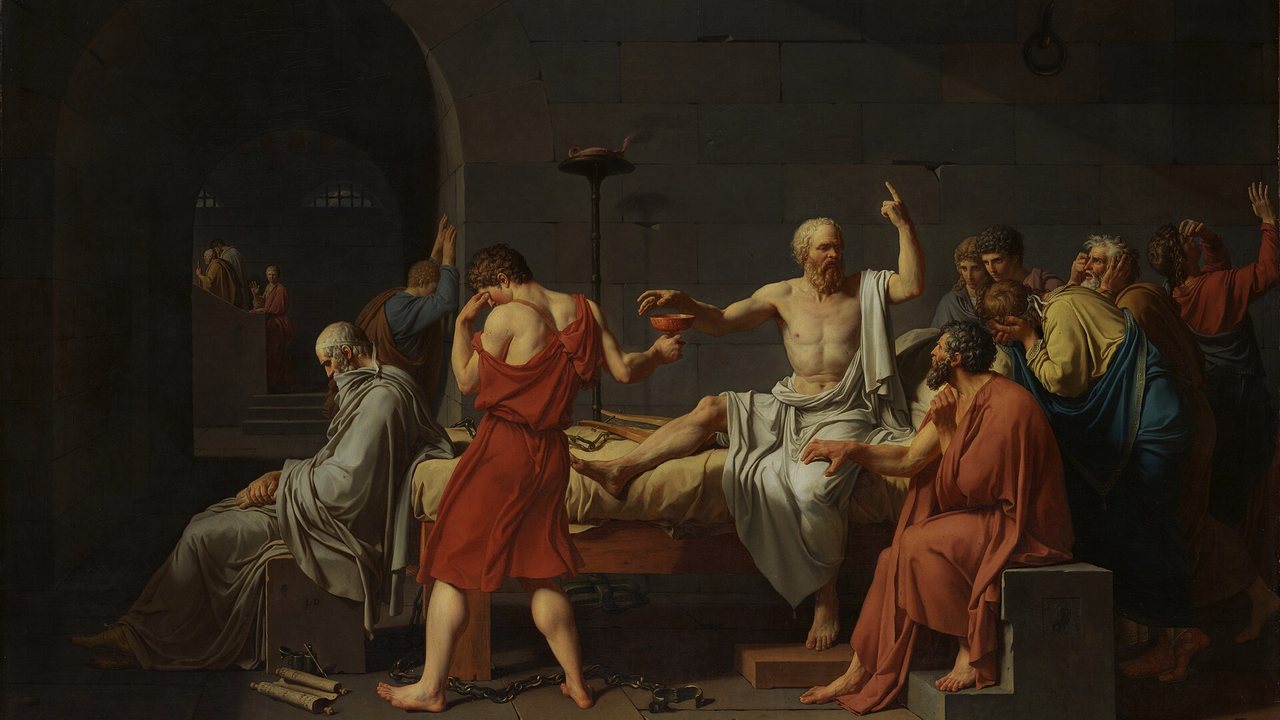
In the Crito, friends arrange his escape from prison. Socrates refuses: he argues that a man who has lived his whole life under the laws of Athens, and benefited from them, cannot break those laws the moment they turn against him. In the Phaedo, he drinks the hemlock calmly, surrounded by his friends. The painting at the top of this page shows that scene.
The examined life
What did Socrates think was worth dying for?
The practice of examining a life. At his trial he told the jury he would not stop questioning people even to save his life, and gave his reason:
"The unexamined life is not worth living for men." Plato, Apology 38a (Grube translation)
An examined life, in Socrates' sense, is not a life spent in a library. An examined life is one in which a person knows why he believes what he believes, and is willing to change a belief when the reasons fail. It is worth noticing, too, that Socrates did not see his questioning as an attack on religion. He described it as a duty to the god of Delphi and spoke of a divine sign, his , that warned him away from wrong actions (Apology 23b, 31d). For Socrates, honest questioning and reverence belonged together. How faith and reason relate is one of the great questions of this course, and Lesson 5 begins it with Augustine's phrase "faith seeking understanding."
Skills to keep
What can you actually do differently after meeting Socrates?
Four habits carry through the rest of this course, and through any hard conversation:
- Define your terms. Before arguing about whether an act is just or loving, say what you mean by just or loving.
- Hunt for counterexamples, starting with your own claims.
- Ask before you tell. A good question often moves a person further than a correction does.
- Welcome aporia. Finding out you do not know is the start of learning, not the end of it.
Try it: five minutes
Pick one word you use often and care about, for example faithful, fair, or friend. Write a one-sentence definition. Then try to write one counterexample: a case that fits your sentence but is not the thing, or is the thing but does not fit. Revise the sentence. Two rounds is a real Socratic workout.
Check yourself
Check yourself
What does the Greek word philosophia mean?
Love of wisdom.
Name the branch of philosophy that asks what knowledge is and how a person gets it.
Epistemology.
What was new about Thales' claim that everything is made of water?
Not the answer, which is wrong, but the move: a claim about all of nature, backed by reasons that others could examine and challenge, instead of a story about the gods.
Why is it hard to know what the historical Socrates believed?
He wrote nothing. We depend on Plato, Xenophon, and Aristophanes, whose portraits differ. That puzzle is the Socratic problem.
According to the Apology, in what way was Socrates wiser than the people he questioned?
They thought they knew things they did not know. Socrates did not think he knew what he did not know.
What is a counterexample?
A case that fits a proposed definition but plainly is not the thing defined, or is the thing but does not fit the definition.
State the Euthyphro dilemma in one sentence.
Is the pious loved by the gods because it is pious, or is it pious because the gods love it?
Why did Socrates refuse to escape from prison in the Crito?
He argued that having lived under and benefited from the laws of Athens, he could not rightly break them when they turned against him.
Check yourself with a quick quiz
A few questions on this lesson only. Questions you miss come back later. Progress stays in this browser and is shared with the full quiz.
Top image: Jacques-Louis David, The Death of Socrates, 1787, The Metropolitan Museum of Art. Public domain.
References
- David, J.-L. (1787). The death of Socrates [Oil on canvas]. The Metropolitan Museum of Art, New York (Catharine Lorillard Wolfe Collection, 31.45). Public domain. Page image cropped and darkened. https://www.metmuseum.org/art/collection/search/436105
- Kenny, A. (2010). A new history of Western philosophy. Oxford University Press. Part 1, chapter 1.
- Nails, D., & Monoson, S. S. (2022). Socrates. In E. N. Zalta & U. Nodelman (Eds.), The Stanford encyclopedia of philosophy (Summer 2022 ed.). https://plato.stanford.edu/entries/socrates/
- O'Grady, P. (n.d.). Thales of Miletus. In Internet encyclopedia of philosophy. https://iep.utm.edu/thales/
- Perry, J., Bratman, M., & Fischer, J. M. (Eds.). (2016). Introduction to philosophy: Classical and contemporary readings (7th ed.). Oxford University Press.
- Plato. (2002). Five dialogues: Euthyphro, Apology, Crito, Meno, Phaedo (G. M. A. Grube, Trans.; J. M. Cooper, Rev.; 2nd ed.). Hackett. Cited by standard Stephanus numbers (for example, Apology 21d).
- Plato. (n.d.). Laches (B. Jowett, Trans.). Project Gutenberg. https://www.gutenberg.org/ebooks/1584
Image and media credits
- Top image. Jacques-Louis David, The Death of Socrates, 1787, oil on canvas, cropped and darkened. Socrates is the center of this lesson on philosophy and the examined life. Source: The Metropolitan Museum of Art, accession 31.45 (museum page), via Wikimedia Commons. License: Public domain (the Met lists it as Open Access).
- Read-aloud audio. Narration of this page. It lets you listen to the lesson instead of reading it. Source: Created for this site: this page's text read by a computer-generated voice (Microsoft text-to-speech, Andrew voice). License: Our own text; the synthetic voice is Microsoft's.
- Diagrams and interactive figures. Every diagram and interactive figure on this page. They show the ideas in the text step by step. Source: Created for this site. License: Original to mattgaugerx.com.

