When two people disagree, how could you tell whose reasons are better without simply picking the side you already like?
You look at the reasons themselves, not at the people. is the part of philosophy that studies when reasons actually support a conclusion. Lesson 1 showed Socrates testing beliefs by asking questions. Logic gives that testing a set of tools: a way to lay an argument out, a test for whether its conclusion follows, and a list of the most common ways reasoning goes wrong (Hurley & Watson, 2018).
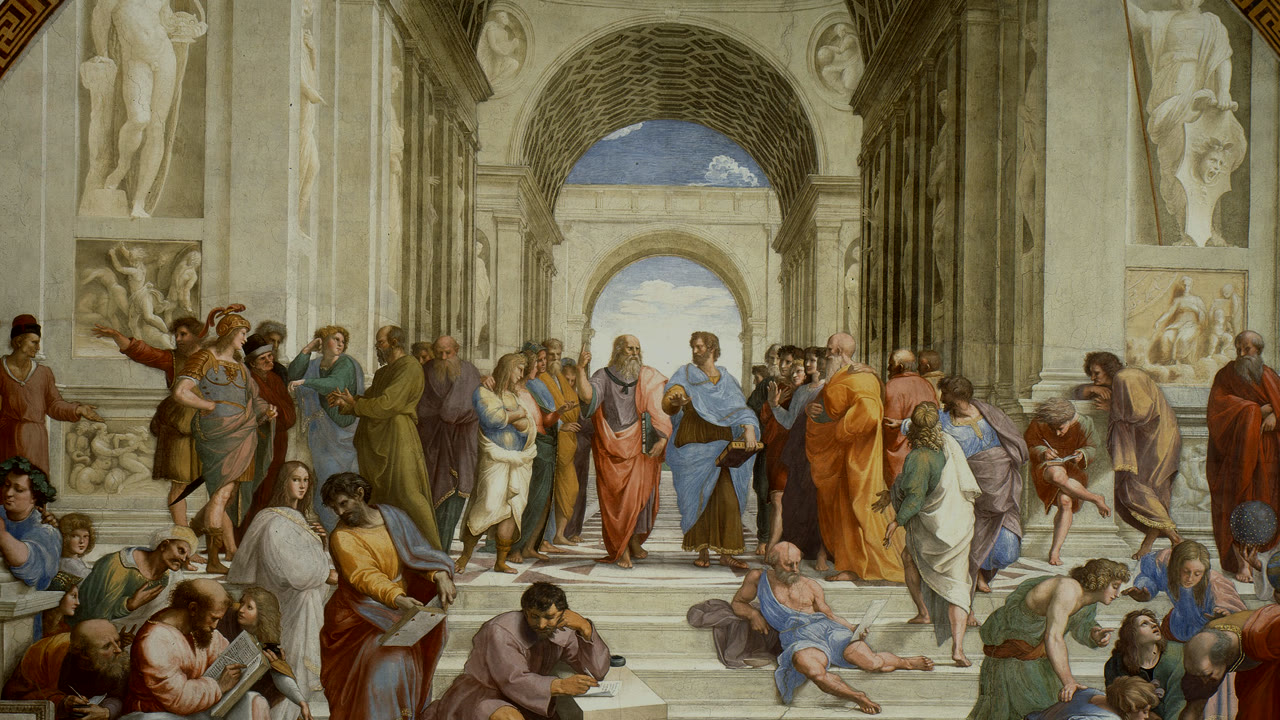
The first person to write those tools down as a system was Aristotle, Plato's student, in the 300s BC. He is the figure on the right at the center of the painting at the top of this page, standing beside Plato.
In one minute
- An argument is premises (reasons) offered in support of a conclusion.
- Deductive arguments aim to guarantee the conclusion; inductive arguments aim to make it probable.
- Valid: if the premises were true, the conclusion would have to be true. Validity is about form.
- Sound: valid and every premise actually true. Only a sound argument proves its conclusion.
- Some forms always work (modus ponens, modus tollens); some only look like they do.
- A fallacy is a mistake in reasoning that can still feel convincing. Learn to name the common ones.
The parts
If an argument is not a shouting match, what is it?
In logic, an is a set of statements in which some statements, the , are offered as reasons to accept another statement, the . A quarrel can happen without any argument at all, and a calm conversation can contain several.
Arguments in real life rarely arrive labeled. Indicator words help. Words such as since, because, and given that usually introduce a premise. Words such as therefore, so, and it follows that usually introduce the conclusion. Writing the premises on separate numbered lines, with the conclusion last, is called putting the argument in standard form. Figure 2.1 does that with the most famous example in the history of logic.
Aristotle's tool
What did Aristotle notice about arguments that nobody had written down before?
That whether an argument works depends on its shape, not on its subject. In the Prior Analytics, Aristotle studied the : an argument with two premises and a conclusion, each relating two groups of things with all, no, or some (Smith, 2022). Replace the words in Figure 2.1 with letters and the pattern appears:
- All B are A. (All humans are mortal.)
- C is a B. (Socrates is a human.)
- So C is A. (Socrates is mortal.)
Any words at all can go in for the letters, and if the premises are true, the conclusion has to be true. Aristotle had found the idea of : the skeleton of an argument, which can be checked without knowing anything about humans, Socrates, or death. His system was the standard logic of the Western world for more than two thousand years, until modern symbolic logic expanded it in the late 1800s.
Validity
Can an argument with a false conclusion still be a good piece of reasoning?
In one important sense, yes. A deductive argument is when it is impossible for all its premises to be true and its conclusion false. Validity asks a conditional question: if the premises were true, would the conclusion have to be true? Validity does not ask whether the premises are in fact true.
So this argument is valid: all fish can fly; a shark is a fish; so a shark can fly. The first premise is false and so is the conclusion, but the form is the same as in Figure 2.1, and the form never lets true premises lead to a false conclusion. The reverse also happens. All dogs are mammals; all cats are mammals; so all cats are dogs. Both premises are true and the argument is invalid, because sharing one group does not make two groups the same.
Soundness
If validity is not enough, what does it take for an argument to prove something?
Validity plus true premises. An argument is when it is valid and all of its premises are actually true. A sound argument cannot have a false conclusion. That gives you exactly two ways to challenge any deductive argument, and Figure 2.2 lays them out: attack the form (show the argument is invalid), or attack a premise (show at least one premise is false).
Forms that work
Are there argument shapes you can trust every time, and shapes that only look trustworthy?
Yes, and the difference is easy to miss in conversation. Many everyday arguments use an if-then premise, called a conditional. Two forms built on a conditional are always valid. ("the way of affirming") confirms the if part and concludes the then part. ("the way of denying") denies the then part and concludes that the if part is false. Each has a counterfeit that looks almost the same and is invalid. Figure 2.3 sets all four side by side using one conditional: if it rained, then the street is wet.
| Form | Second premise | Conclusion | Verdict |
|---|---|---|---|
| Modus ponens | It rained. | So the street is wet. | Valid |
| Modus tollens | The street is not wet. | So it did not rain. | Valid |
| Affirming the consequent | The street is wet. | So it rained. | Invalid: a street sweeper could have wet it. |
| Denying the antecedent | It did not rain. | So the street is not wet. | Invalid: the sweeper again. |
Affirming the consequent is everywhere. "If he were guilty, he would look nervous; he looks nervous; so he is guilty." Nervousness has many causes. Spotting the shape lets you ask the right question: what else could explain this?
Induction
Most of what you believe about tomorrow comes from what happened yesterday. Is that reasoning, or just habit?
It is reasoning, but of a different kind. A aims to guarantee its conclusion. An aims only to make its conclusion probable, usually by reasoning from observed cases to cases not yet observed. Medicine, science, and daily life depend on induction: the drug worked in large trials, so it will probably work for you.
Inductive arguments are not valid or invalid. They are stronger or weaker. An inductive argument is when, if its premises are true, the conclusion is probably true, and when it is strong and its premises really are true. Even a cogent inductive argument can have a false conclusion. For centuries, every swan Europeans had seen was white, and "all swans are white" seemed safe. In 1697 the Dutch explorer Willem de Vlamingh's crew saw black swans in western Australia. Figure 2.4 compares the two kinds of argument.
Fallacies
Why do bad arguments so often win?
Because many of them feel like good ones. A is a mistake in reasoning that can still seem persuasive. Formal fallacies, such as affirming the consequent, are flaws in the form. are flaws in content or context: the premises are irrelevant, too weak, or quietly assume what they claim to prove (Dowden, n.d.). Aristotle catalogued thirteen of them in a short book, Sophistical Refutations. Figure 2.5 is a field guide to eight that show up most often, each with a question that exposes it.
| Fallacy | Example | Question that exposes it |
|---|---|---|
| Ad hominem (attacking the person) | "Don't listen to her argument about taxes; she's rich." | Is the argument itself wrong, whoever makes it? |
| Straw man | "You want safer roads? So you want to ban cars." | Is that what the person actually said? |
| False dilemma | "Either you agree with me or you don't care." | Are these really the only two options? |
| Begging the question (circular reasoning) | "He is trustworthy because he says he never lies." | Does a premise already assume the conclusion? |
| Appeal to unqualified authority | "A famous actor says this diet cures disease." | Is this source an expert on this exact question? |
| Hasty generalization | "My two coworkers from that city were rude, so people there are rude." | Is the sample big and fair enough? |
| Post hoc (after, so because of) | "I wore my lucky shirt and we won, so the shirt helped." | Could something else explain the sequence? |
| Slippery slope | "If we allow one exception, soon there will be no rules at all." | Is each step in the chain actually likely? |
A warning that runs the other way: calling out a fallacy does not prove the conclusion false. A bad argument can be offered for a true conclusion. Deciding that a claim must be false because someone defended it badly is itself a fallacy, sometimes called the fallacy fallacy.
Charity
Once you can spot weak arguments, what keeps logic from turning into a weapon?
A rule philosophers call the : before you criticize an argument, restate it in its strongest reasonable form, the version its best defender would recognize. Some people call that steelmanning, the opposite of building a straw man. Charity is fair to the other person, and it is also smart. If you defeat only the weakest version of a view, you have learned nothing about whether the view is true.
Socrates, in Lesson 1, asked questions before he objected. Charity is the same habit in logical form: understand first, then test. Disagreement done this way stays respectful, and it is far more likely to change a mind, including your own.
Skills to keep
What can you do differently the next time someone tries to convince you of something?
- Find the conclusion first. Ask: what exactly am I being asked to believe?
- List the premises. Put the reasons on separate lines, including any the speaker left unstated.
- Test the form. If every premise were true, would the conclusion have to follow, or only probably follow?
- Test the premises. Which one is most likely false, and how would you check it?
- Be charitable. Fix the argument's easy flaws yourself before you judge it.
Try it: five minutes
Pick one persuasive message you saw today: an ad, a headline, or a post. Write its conclusion in one sentence. Below it, list the premises as numbered lines, adding any premise it quietly assumes. Then mark it deductive or inductive, ask whether the form works, and circle the weakest premise. If you spot a fallacy from Figure 2.5, write the question that exposes it.
Check yourself
Check yourself
In logic, what is an argument?
A set of statements in which some (the premises) are offered as reasons to accept another (the conclusion).
What does it mean for a deductive argument to be valid?
It is impossible for all its premises to be true and its conclusion false. Validity is about form, not about whether the premises are actually true.
Can a valid argument have a false conclusion?
Yes, if at least one premise is false. "All fish can fly; a shark is a fish; so a shark can fly" is valid but unsound.
What two things make an argument sound?
It is valid, and all of its premises are true.
"If he studied, he passed. He passed. So he studied." Which form is this, and is it valid?
Affirming the consequent. Invalid: he could have passed for another reason.
How is a strong inductive argument different from a valid deductive one?
A strong inductive argument makes its conclusion probable; true premises still leave room for a false conclusion. A valid deductive argument with true premises guarantees its conclusion.
"You think we should cut the budget? So you don't care about children." Name the fallacy.
Straw man (it may also set up a false dilemma). It replaces the actual claim with a weaker, easier one.
What is the principle of charity?
Restating an argument in its strongest reasonable form before criticizing it.
Check yourself with a quick quiz
A few questions on this lesson only. Questions you miss come back later. Progress stays in this browser and is shared with the full quiz.
Top image: Raphael, The School of Athens, 1509-1511, Apostolic Palace, Vatican City. Public domain.
References
- Aristotle. (1984). Prior analytics (A. J. Jenkinson, Trans.). In J. Barnes (Ed.), The complete works of Aristotle (Vol. 1). Princeton University Press.
- Aristotle. (1984). Sophistical refutations (W. A. Pickard-Cambridge, Trans.). In J. Barnes (Ed.), The complete works of Aristotle (Vol. 1). Princeton University Press.
- Copi, I. M., Cohen, C., & Rodych, V. (2019). Introduction to logic (15th ed.). Routledge.
- Dowden, B. (n.d.). Fallacies. In Internet encyclopedia of philosophy. https://iep.utm.edu/fallacy/
- Hurley, P. J., & Watson, L. (2018). A concise introduction to logic (13th ed.). Cengage.
- Perry, J., Bratman, M., & Fischer, J. M. (Eds.). (2016). Introduction to philosophy: Classical and contemporary readings (7th ed.). Oxford University Press.
- Raphael. (1509-1511). The school of Athens [Fresco]. Stanza della Segnatura, Apostolic Palace, Vatican City. Public domain. Page image cropped and darkened. Wikimedia Commons
- Smith, R. (2022). Aristotle's logic. In E. N. Zalta & U. Nodelman (Eds.), The Stanford encyclopedia of philosophy (Winter 2022 ed.). https://plato.stanford.edu/entries/aristotle-logic/
Image and media credits
- Top image. Raphael, The School of Athens, 1509 to 1511, fresco in the Apostolic Palace, Vatican City, cropped and darkened. It shows the ancient philosophers who first set out the rules of argument taught in this lesson. Source: Wikimedia Commons. License: Public domain (faithful photograph of a 500-year-old painting).
- Read-aloud audio. Narration of this page. It lets you listen to the lesson instead of reading it. Source: Created for this site: this page's text read by a computer-generated voice (Microsoft text-to-speech, Andrew voice). License: Our own text; the synthetic voice is Microsoft's.
- Diagrams and interactive figures. Every diagram and interactive figure on this page. They show the ideas in the text step by step. Source: Created for this site. License: Original to mattgaugerx.com.

