No one left a written record of the first prayer or the first funeral. So how could anyone know when religion began, or why?
Writing is only about five thousand years old, and people were burying their dead and painting cave walls tens of thousands of years before that. To ask where religion came from, scholars have to work like detectives with very few clues: bones in a pit, pigment on a rock, carved stone pillars, and the minds of living people. This lesson looks at that evidence and at the main theories built on it.
Two warnings come first. The evidence is thin, and almost every famous claim about prehistoric religion has serious critics, so this lesson shows you both sides. And even a strong theory of how religious belief arose would not, by itself, tell us whether any religious belief is true. Lesson 1 called the stance that keeps those two questions apart methodological agnosticism, and this lesson leans on it heavily.
In one minute
- Deliberate burial is at least 78,000 years old in Africa; probably buried some of their dead too. What burial meant to them is unknown.
- Cave art is at least 45,000 years old. Hunting magic, symbolic structure, and shamanic trance have all been proposed; none is proven.
- At , hunter-gatherers raised huge carved pillars about 11,000 years ago. Whether it was a "temple" is debated.
- Tylor's animism saw belief in spirits as early, mistaken reasoning. The new animism treats it as a way of living with .
- The cognitive science of religion asks which ordinary mental tools, such as agency detection and theory of mind, make religious ideas easy to think and remember.
- Evolutionary accounts disagree: is religion a byproduct of those tools or an adaptation for cooperation? The "big gods" debate is still open.
- Explaining how a belief arose does not settle whether it is true.
The first burials
Does burying the dead mean believing in an afterlife?
Not necessarily, and archaeologists are careful about the difference. A means someone dug a pit or prepared a place and laid a body in it on purpose. That shows care for the dead. It does not, by itself, show a belief in souls, gods, or a life after death, since people bury the dead for many reasons, including grief, hygiene, and keeping scavengers away.
The earliest known burial in Africa is that of a child of about three, found in the cave of Panga ya Saidi on the coast of Kenya. About 78,000 years ago someone placed the child in a dug pit, lying on one side with the legs drawn up, and the position of the head suggests it may have rested on something soft, perhaps a pillow that has since decayed (Martinón-Torres et al., 2021). Neanderthals, a different human population that lived in Europe and western Asia, also seem to have buried some of their dead. At Shanidar Cave in Iraq, excavators in 2018 found a new Neanderthal, known as Shanidar Z, dating to roughly 70,000 to 60,000 years ago, in a setting that suggests deliberate burial (Pomeroy et al., 2020).
Shanidar is also a lesson in caution. Pollen found in the soil beside another skeleton there, excavated in 1960, led to the famous idea of a Neanderthal "flower burial," with mourners laying blossoms on the grave (Solecki, 1975). A later study concluded that the pollen was more likely carried in by ground-nesting bees, and that the flower burial is unlikely (Hunt et al., 2023). The same kind of argument surrounds the Neanderthal skeleton found in 1908 at La Chapelle-aux-Saints in France. One team argued from new fieldwork that the body lay in a pit dug by its group and was quickly covered (Rendu et al., 2014); another argued that the pit could be natural and the evidence for burial was weak (Dibble et al., 2015). Figure 2.1 places the main sites in this lesson on one timeline.
Images in the dark
Why would anyone paint animals deep inside a cave where almost no one could see them?
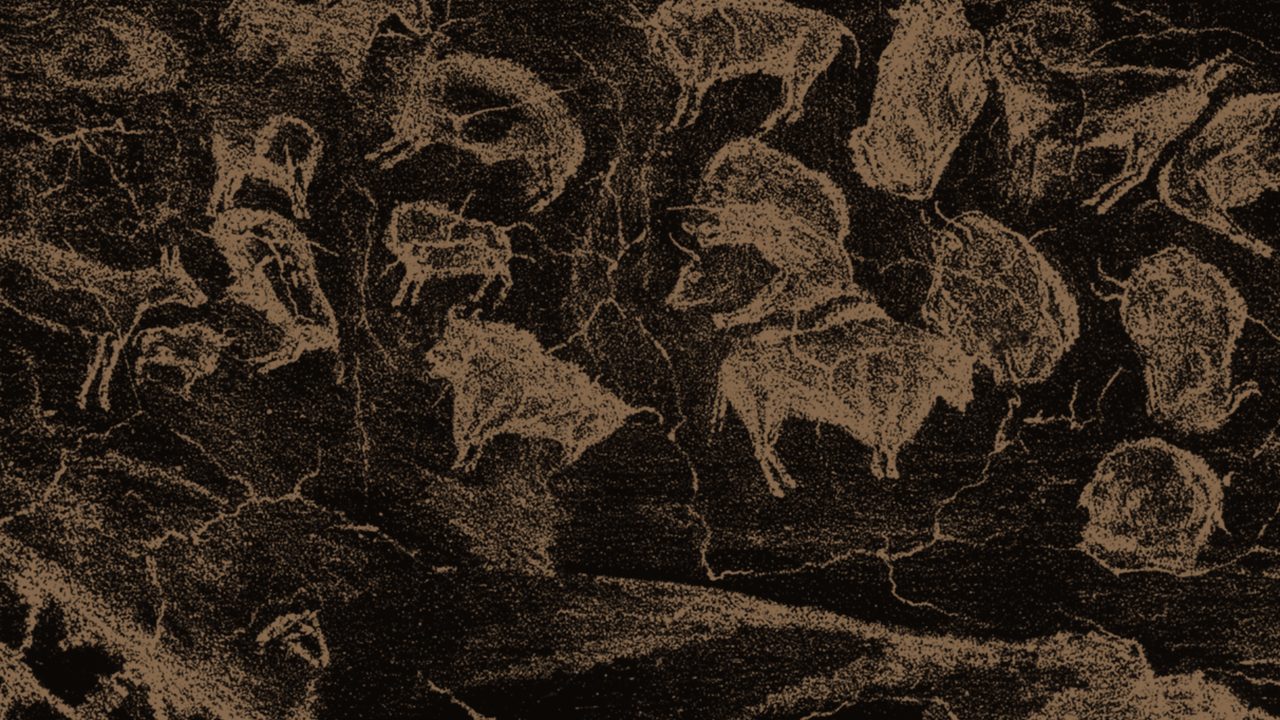
That question has puzzled scholars since the first great painted cave was recognized. In 1879 the Spanish landowner Marcelino Sanz de Sautuola explored the cave of Altamira in northern Spain, and, in the usual account, his young daughter Maria drew his attention to bison painted on the ceiling. Sautuola published a drawing of them in 1880; that drawing is the image at the top of this page. Many experts dismissed the paintings as too skilled to be ancient. In 1902 the French prehistorian Emile Cartailhac, one of the leading doubters, publicly took back his objection in an article he titled "Mea culpa of a skeptic" (Cartailhac, 1902).
The dates have only grown older since. A painted wild pig in the cave of Leang Tedongnge on the Indonesian island of Sulawesi is at least 45,500 years old (Brumm et al., 2021). In Chauvet Cave in southern France, most of the black drawings of lions, horses, and rhinoceroses were made between about 37,000 and 33,500 years ago (Quiles et al., 2016). The art is real and ancient. What it meant is the hard question, and three main answers have been offered, summarized in Figure 2.2.
Early in the 1900s the French priest and prehistorian Henri Breuil championed the idea of : painting an animal would help hunters find or kill it (Breuil, 1952). Critics noted that the animals painted most often were not always the ones people ate most. In the 1960s the French scholar Andre Leroi-Gourhan argued instead for a symbolic structure: pairs of animals, such as horse and bison, placed by plan in different parts of a cave (Leroi-Gourhan, 1967).
The most debated recent theory comes from the South African archaeologist David Lewis-Williams. Working first on the rock art of the San peoples of southern Africa, whose own accounts link some paintings to the trance experiences of healers, he and Thomas Dowson proposed that some Paleolithic art records altered states of consciousness. They pointed to , the dots, zigzags, and grids the human nervous system can produce in trance, and argued that such signs appear alongside the animals (Lewis-Williams & Dowson, 1988). In The Mind in the Cave Lewis-Williams went further and suggested that the cave wall was experienced as a thin membrane between this world and a spirit world (Lewis-Williams, 2002).
The critics are many. The British archaeologist Paul Bahn has argued that the shamanism reading stretches thin evidence across very different times and places and is difficult to test (Bahn, 2010). The anthropologist Alice Beck Kehoe argued that "," a word taken from one Siberian people, has been used too loosely by Western writers, who then find shamans everywhere (Kehoe, 2000). Many prehistorians now conclude that the art probably served more than one purpose and that we may never know what it meant to the people who made it.
| Interpretation | Main idea | Evidence it points to | Main objection |
|---|---|---|---|
| Hunting magic (Breuil) | Painting an animal helped hunters succeed | Large game animals dominate the art | The animals painted are often not the ones most often eaten |
| Symbolic structure (Leroi-Gourhan) | Paired animals and signs placed by plan in the cave | Repeated pairings, such as horse and bison | Many caves were painted over thousands of years, not to one plan |
| Shamanic trance (Lewis-Williams) | Images record or reach a spirit world seen in altered states | Geometric signs like those seen in trance; San rock art accounts | Stretches one model across tens of thousands of years; difficult to test (Bahn, Kehoe) |
Göbekli Tepe
Did ritual come before farming and towns, or after them?
For a long time the usual story ran in one direction: people first stopped wandering, built villages, and farmed, and only then had the surplus to build monuments. Göbekli Tepe, a hilltop site in southeastern Turkey, complicated that story. UNESCO, which listed it as a World Heritage Site in 2018, describes round and rectangular megalithic structures built by hunter-gatherers between about 9600 and 8200 BCE (UNESCO, 2018). Many of the T-shaped limestone pillars are carved with foxes, boars, snakes, vultures, and other wild animals, and some have carved arms and hands, as if the pillars stood for human-like figures.
The German archaeologist Klaus Schmidt, who led excavations there from the 1990s until his death in 2014, interpreted the enclosures as ritual monuments built by people who gathered for feasts. His team reported huge numbers of animal bones and large stone vessels, and suggested, more tentatively, that cereals may have been brewed into a kind of beer for those gatherings (Dietrich et al., 2012). If they are right, ritual and feasting helped draw people together before farming was fully established.
Not everyone accepts the "temple" label. The Canadian archaeologist E. B. Banning argued that the sharp line between a sacred temple and an ordinary house may be a modern habit, and that the buildings at Göbekli Tepe may have been houses in which ritual was woven into daily life (Banning, 2011). UNESCO's own summary is cautious: the structures were probably used for rituals, most likely funerary ones (UNESCO, 2018). For this course the safe conclusion is this: some hunter-gatherers invested enormous labor in carved monuments, and the meaning of those monuments is still being worked out.
Animism, old and new
Is belief in spirits a mistake about the world, or a different way of relating to it?
Lesson 1 introduced Edward Burnett Tylor, who defined religion as belief in spiritual beings. Tylor also offered a theory of where that belief came from. He imagined early humans reflecting on dreams, visions, illness, and death. In a dream a person seems to travel while the body lies still; at death something seems to leave. From such experiences, Tylor argued, people inferred a soul that could separate from the body, and then extended souls to animals, plants, and objects. He called this belief and treated it as the root of all religion (Tylor, 1871).
Tylor took animism seriously as reasoning, but he also treated it as an early, mistaken stage of thought that science would replace, a view tied to the Victorian idea that all cultures climb the same ladder of progress. Most anthropologists have since abandoned that ladder.
A different approach, often called the new animism, starts from how animist peoples actually live and speak. The American anthropologist A. Irving Hallowell, writing about the Ojibwe people of the Great Lakes region, described a world that includes "other-than-human persons," such as certain animals, stones, and winds, with whom people have relationships (Hallowell, 1960). The Israeli anthropologist Nurit Bird-David, who lived among the Nayaka, a forest people of southern India, argued that animism is less a theory about hidden spirits than a : a way of knowing things by engaging with them as partners in a relationship, the way one comes to know a neighbor (Bird-David, 1999). The British scholar of religion Graham Harvey summed up the approach by describing animists as people who recognize that the world is full of persons, only some of whom are human (Harvey, 2005). Figure 2.3 compares the two views.
| Question | Tylor's animism (1871) | The new animism (Hallowell, Bird-David, Harvey) |
|---|---|---|
| What is animism? | Belief in souls and spirits inside people, animals, and things | A way of living with other-than-human persons and relating to them |
| Where does it come from? | Early humans reasoning about dreams, visions, and death | Daily relationships with animals, plants, places, and weather |
| Is it a mistake? | Yes: an early stage of thought that science corrects | The question is set aside; the goal is to understand it on its own terms |
| Main criticism | Assumes one ladder of progress, with Europeans at the top | May romanticize Indigenous peoples or blur real differences among them |
The religious mind
Are some religious ideas simply easier for human minds to think?
That is the central claim of the , a field that took shape in the 1990s. It does not ask whether religious ideas are true. It asks which ordinary mental tools, shared by all humans, make certain ideas easy to grasp, remember, and pass on (Barrett, 2000). Three tools get the most attention, shown in Figure 2.4.
The first is . The anthropologist Stewart Guthrie argued that humans tend to see faces in clouds and intentions in random events, and that this habit lies behind much religious thought (Guthrie, 1993). The psychologist Justin Barrett described a mental system that is quick to suspect an agent, someone who acts on purpose, behind a rustle in the grass. He called it a hyperactive, or hypersensitive, agency detection device, often shortened to HADD (Barrett, 2000, 2004). The usual explanation is a cost difference: mistaking the wind for a predator costs little, while mistaking a predator for the wind could cost your life.
The second is , the ability to think about what others believe, want, and intend. Praying, making an offering, or wondering what an ancestor wants all draw on it. One set of studies found that people who scored lower on tests of this ability reported weaker belief in a personal God, on average (Norenzayan et al., 2012). A later and larger study did not find that link, and found instead that belief tracked how much people had seen others around them act on their faith (Maij et al., 2017). The question is still open.
The third concerns memory. The anthropologist Pascal Boyer argued that religious concepts tend to be : they break one or two of our basic expectations about a kind of thing and keep the rest. A spirit is like a person who can pass through walls; a statue is like an object that can hear prayers. Concepts of this kind stand out without becoming too strange to use (Boyer, 2001). In memory experiments in France, Gabon, and Nepal, invented stories with such violations were recalled better than stories with ordinary oddities (Boyer & Ramble, 2001). The anthropologist Scott Atran made a similar case and stressed that religions also depend on emotion, ritual, and commitment, not memory alone (Atran, 2002).
Evolution and cooperation
Did religion help our ancestors survive, or is it a side effect of minds built for other jobs?
Evolutionary accounts of religion fall into two broad families. The view, held by Boyer and Atran among others, says that religion was not itself selected for. It rides on mental tools, like agency detection and theory of mind, that evolved for other purposes, much as the ability to read rides on brain systems that evolved long before writing (Boyer, 2001; Atran, 2002). The view says that religion, or parts of it, spread because it helped individuals or groups do better, especially at cooperating. The biologist David Sloan Wilson argued that religious groups can work like well-organized teams that outcompete less united ones (Wilson, 2002).
One adaptation theory focuses on cost. The anthropologist Richard Sosis argued that demanding rituals and rules work as : because they are difficult to fake, they show other members that a person is truly committed, which makes trust easier (Sosis & Alcorta, 2003). To test this, Sosis and Eric Bressler studied 83 communes founded in the United States in the 1800s. Religious communes tended to last longer than secular ones, and among the religious communes, those that asked more of their members, in matters such as food, dress, and possessions, survived longer. The same pattern did not hold for the secular communes (Sosis & Bressler, 2003).
The big gods debate
Did belief in watchful, moralizing gods help strangers trust each other, or did it arrive only after large societies had formed?
The social psychologist Ara Norenzayan proposed the . Small foraging bands, he noted, often have gods or spirits that care little about human morality. Many large societies worship gods who see everything and punish wrongdoing. Norenzayan argued that belief in such moralizing gods helped large groups of strangers cooperate, because people who feel watched tend to behave better, and that these beliefs spread through competition among cultures (Norenzayan, 2013; Norenzayan et al., 2016). In a study of 591 people in eight communities around the world, those who described their gods as more knowing and more punishing tended to share more money with distant strangers of the same faith in an economic game (Purzycki et al., 2016).
The hypothesis also makes a prediction about history: moralizing gods should appear before or alongside the growth of large, complex societies. In 2019 a team led by Harvey Whitehouse tested that prediction with a large historical database called Seshat, which covered 414 societies in 30 regions. The team reported in Nature that moralizing gods tended to appear only after societies had grown to around a million people, which seemed to reverse the causal arrow (Whitehouse et al., 2019).
Then the debate turned on the data. Another team of researchers showed that in the 2019 analysis many cases where information about moralizing gods was simply missing had been treated as if such gods were absent. Correcting that choice, they argued, removed the support for the original conclusion (Beheim et al., 2021). In July 2021 Nature retracted the 2019 paper. In the note the authors accepted that they should have coded those cases differently. They also stated that their refined analyses still strongly supported their original conclusion, and three of the authors did not agree with the retraction at all (Whitehouse et al., 2021). Both sides continue to publish on the question. Figure 2.5 traces the sequence.
The episode does not show that the big gods hypothesis is right, and it does not show that it is wrong. It shows how much the answer depends on careful coding of thin historical evidence, and why a single striking study should not settle a large question.
Origins and truth
If science could explain exactly why humans believe in gods, would that prove the gods are not real?
No, and this is the most important point in the lesson. How a belief came about and whether it is true are separate questions. Our ability to see depth evolved because it helped our ancestors survive, yet no one concludes from this that distant objects are an illusion. In the same way, a complete account of why minds find spirits and gods natural would leave open whether any spirit or god exists. Judging a claim true or false only by where it came from is a mistake in reasoning that logicians call the ; PHIL 101 Lesson 2 shows how to spot fallacies of this kind.
Scholars inside the field read the evidence differently. Some see natural explanations as accounting for religion without anything beyond nature. Others, including Justin Barrett, argue that a natural tendency toward belief fits just as well with the view that belief is reasonable (Barrett, 2004). Religious studies does not referee that dispute. Using the methodological agnosticism from Lesson 1, it describes the evidence and the theories, and leaves the question of truth to philosophy, to theology, and to you (Smart, 1973). The truth question still matters; it is simply a different job, done with different tools.
Skills to keep
What will you do differently the next time you hear a claim about the origins of religion?
Four habits from this lesson carry forward:
- Separate the find from the story. A pit, a painting, or a pillar is evidence; "afterlife belief," "hunting magic," and "temple" are interpretations. Ask what the find shows by itself.
- Look for the critics. Almost every famous claim in this lesson has serious challengers. A fair summary names both sides.
- Watch the data. The big gods debate turned on how missing data were coded. Before trusting a striking result, ask how the evidence was counted.
- Keep origin and truth apart. Explaining how a belief arose does not settle whether it is true, in either direction.
Try it: ten minutes
Find a news story about an archaeological discovery described as "religious" or "ritual," or use one from this lesson. Draw two columns. In the first, list only what was physically found. In the second, list every interpretation the story adds. Then ask: which interpretations does the evidence require, which does it merely allow, and what other explanation could fit the same find?
Check yourself
Check yourself
Why does a deliberate burial not prove a belief in an afterlife?
Burial shows care for the dead, but people bury the dead for many reasons, including grief, hygiene, and protection from scavengers. A burial alone does not reveal what the mourners believed.
What happened to the Shanidar "flower burial" idea?
Pollen near a Neanderthal skeleton was once read as flowers laid on a grave. A later study concluded the pollen was more likely brought in by ground-nesting bees, so the flower burial is now thought unlikely.
What is Lewis-Williams's theory of cave art, and what is the main criticism of it?
He argued that some cave art records altered states of consciousness, pointing to geometric signs like those produced in trance and to San rock art. Critics such as Bahn and Kehoe say it stretches one model across very different times and places and is difficult to test.
Why is Göbekli Tepe important, and why is the word "temple" debated?
Hunter-gatherers built large carved stone enclosures there about 11,000 years ago, before farming was fully established. Banning and others argue that the buildings may have been houses with ritual woven into daily life, so "temple" may impose a modern line between sacred and ordinary.
How does the new animism differ from Tylor's animism?
Tylor treated animism as an early, mistaken belief in souls. The new animism, from Hallowell, Bird-David, and Harvey, describes it as a way of relating to other-than-human persons and sets aside the question of whether it is a mistake.
What is a hyperactive agency detection device (HADD)?
Barrett's name for the human tendency to sense an agent, someone acting on purpose, behind ambiguous events. Missing a real agent can be costly, so the system errs on the side of seeing agents.
What is a minimally counterintuitive concept? Give an example.
A concept that breaks one or two basic expectations about its kind and keeps the rest, such as a person who can pass through walls. Boyer argued such concepts are easy to remember and pass on.
What is the difference between byproduct and adaptation accounts of religion?
Byproduct accounts say religion rides on mental tools that evolved for other jobs. Adaptation accounts say religion, or parts of it, spread because it helped people survive or cooperate, for example through costly signals of commitment.
What is the big gods hypothesis, and what happened to the 2019 study that challenged it?
Norenzayan proposed that belief in watchful, moralizing gods helped large groups of strangers cooperate. A 2019 Nature study reported that such gods appeared only after societies grew large, but it was retracted in 2021 after critics showed missing data had been coded as absence. The authors still defend their conclusion, so the question remains open.
Why does explaining the origin of a belief not settle whether it is true?
Where a belief came from and whether it is true are separate questions. Judging truth by origin alone is the genetic fallacy.
Check yourself with a quick quiz
A few questions on this lesson only. Questions you miss come back later. Progress stays in this browser and is shared with the full quiz.
Top image: Marcelino Sanz de Sautuola, drawing of the painted ceiling of Altamira cave, published 1880. Public domain.
References
- Atran, S. (2002). In gods we trust: The evolutionary landscape of religion. Oxford University Press.
- Bahn, P. G. (2010). Prehistoric rock art: Polemics and progress. Cambridge University Press. https://doi.org/10.1017/CBO9780511761454
- Banning, E. B. (2011). So fair a house: Göbekli Tepe and the identification of temples in the Pre-Pottery Neolithic of the Near East. Current Anthropology, 52(5), 619–660. https://doi.org/10.1086/661207
- Barrett, J. L. (2000). Exploring the natural foundations of religion. Trends in Cognitive Sciences, 4(1), 29–34. https://doi.org/10.1016/S1364-6613(99)01419-9
- Barrett, J. L. (2004). Why would anyone believe in God? AltaMira Press.
- Beheim, B., Atkinson, Q. D., Bulbulia, J., Gervais, W., Gray, R. D., Henrich, J., et al. (2021). Treatment of missing data determined conclusions regarding moralizing gods. Nature, 595(7866), E29–E34. https://doi.org/10.1038/s41586-021-03655-4
- Bird-David, N. (1999). "Animism" revisited: Personhood, environment, and relational epistemology. Current Anthropology, 40(S1), S67–S91. https://doi.org/10.1086/200061
- Boyer, P. (2001). Religion explained: The evolutionary origins of religious thought. Basic Books.
- Boyer, P., & Ramble, C. (2001). Cognitive templates for religious concepts: Cross-cultural evidence for recall of counter-intuitive representations. Cognitive Science, 25(4), 535–564. https://doi.org/10.1207/s15516709cog2504_2
- Breuil, H. (1952). Four hundred centuries of cave art (M. E. Boyle, Trans.). Centre d'Études et de Documentation Préhistoriques.
- Brumm, A., Oktaviana, A. A., Burhan, B., Hakim, B., Lebe, R., Zhao, J., et al. (2021). Oldest cave art found in Sulawesi. Science Advances, 7(3), eabd4648. https://doi.org/10.1126/sciadv.abd4648
- Cartailhac, E. (1902). Les cavernes ornées de dessins. La grotte d'Altamira, Espagne. "Mea culpa" d'un sceptique. L'Anthropologie, 13, 348–354.
- Dibble, H. L., Aldeias, V., Goldberg, P., McPherron, S. P., Sandgathe, D., & Steele, T. E. (2015). A critical look at evidence from La Chapelle-aux-Saints supporting an intentional Neandertal burial. Journal of Archaeological Science, 53, 649–657. https://doi.org/10.1016/j.jas.2014.04.019
- Dietrich, O., Heun, M., Notroff, J., Schmidt, K., & Zarnkow, M. (2012). The role of cult and feasting in the emergence of Neolithic communities: New evidence from Göbekli Tepe, south-eastern Turkey. Antiquity, 86(333), 674–695. https://doi.org/10.1017/S0003598X00047840
- Guthrie, S. E. (1993). Faces in the clouds: A new theory of religion. Oxford University Press.
- Hallowell, A. I. (1960). Ojibwa ontology, behavior, and world view. In S. Diamond (Ed.), Culture in history: Essays in honor of Paul Radin. Columbia University Press.
- Harvey, G. (2005). Animism: Respecting the living world. Hurst.
- Hunt, C. O., Pomeroy, E., Reynolds, T., Tilby, E., & Barker, G. (2023). Shanidar et ses fleurs? Reflections on the palynology of the Neanderthal "Flower Burial" hypothesis. Journal of Archaeological Science, 159, 105822. https://doi.org/10.1016/j.jas.2023.105822
- Kehoe, A. B. (2000). Shamans and religion: An anthropological exploration in critical thinking. Waveland Press.
- Leroi-Gourhan, A. (1967). Treasures of prehistoric art (N. Guterman, Trans.). Harry N. Abrams. (Original work published 1965)
- Lewis-Williams, J. D. (2002). The mind in the cave: Consciousness and the origins of art. Thames & Hudson.
- Lewis-Williams, J. D., & Dowson, T. A. (1988). The signs of all times: Entoptic phenomena in Upper Palaeolithic art [with comments and reply]. Current Anthropology, 29(2), 201–245. https://doi.org/10.1086/203629
- Maij, D. L. R., van Harreveld, F., Gervais, W., Schrag, Y., Mohr, C., & van Elk, M. (2017). Mentalizing skills do not differentiate believers from non-believers, but credibility enhancing displays do. PLOS ONE, 12(8), e0182764. https://doi.org/10.1371/journal.pone.0182764
- Martinón-Torres, M., d'Errico, F., Santos, E., Álvaro Gallo, A., Amano, N., Archer, W., et al. (2021). Earliest known human burial in Africa. Nature, 593(7857), 95–100. https://doi.org/10.1038/s41586-021-03457-8
- Norenzayan, A. (2013). Big gods: How religion transformed cooperation and conflict. Princeton University Press.
- Norenzayan, A., Gervais, W. M., & Trzesniewski, K. H. (2012). Mentalizing deficits constrain belief in a personal God. PLoS ONE, 7(5), e36880. https://doi.org/10.1371/journal.pone.0036880
- Norenzayan, A., Shariff, A. F., Gervais, W. M., Willard, A. K., McNamara, R. A., Slingerland, E., & Henrich, J. (2016). The cultural evolution of prosocial religions. Behavioral and Brain Sciences, 39, e1. https://doi.org/10.1017/S0140525X14001356
- Pomeroy, E., Bennett, P., Hunt, C. O., Reynolds, T., Farr, L., Frouin, M., et al. (2020). New Neanderthal remains associated with the "flower burial" at Shanidar Cave. Antiquity, 94(373), 11–26. https://doi.org/10.15184/aqy.2019.207
- Purzycki, B. G., Apicella, C., Atkinson, Q. D., Cohen, E., McNamara, R. A., Willard, A. K., et al. (2016). Moralistic gods, supernatural punishment and the expansion of human sociality. Nature, 530(7590), 327–330. https://doi.org/10.1038/nature16980
- Quiles, A., Valladas, H., Bocherens, H., Delqué-Količ, E., Kaltnecker, E., van der Plicht, J., et al. (2016). A high-precision chronological model for the decorated Upper Paleolithic cave of Chauvet-Pont d'Arc, Ardèche, France. Proceedings of the National Academy of Sciences, 113(17), 4670–4675. https://doi.org/10.1073/pnas.1523158113
- Rendu, W., Beauval, C., Crevecoeur, I., Bayle, P., Balzeau, A., Bismuth, T., et al. (2014). Evidence supporting an intentional Neandertal burial at La Chapelle-aux-Saints. Proceedings of the National Academy of Sciences, 111(1), 81–86. https://doi.org/10.1073/pnas.1316780110
- Sanz de Sautuola, M. (1880). Breves apuntes sobre algunos objetos prehistóricos de la provincia de Santander. Santander. Ceiling drawing via Wikimedia Commons, public domain; page image cropped, inverted, and tinted. https://commons.wikimedia.org/wiki/File:Altamira-1880.jpg
- Smart, N. (1973). The science of religion and the sociology of knowledge: Some methodological questions. Princeton University Press.
- Solecki, R. S. (1975). Shanidar IV, a Neanderthal flower burial in northern Iraq. Science, 190(4217), 880–881. https://doi.org/10.1126/science.190.4217.880
- Sosis, R., & Alcorta, C. (2003). Signaling, solidarity, and the sacred: The evolution of religious behavior. Evolutionary Anthropology, 12(6), 264–274. https://doi.org/10.1002/evan.10120
- Sosis, R., & Bressler, E. R. (2003). Cooperation and commune longevity: A test of the costly signaling theory of religion. Cross-Cultural Research, 37(2), 211–239. https://doi.org/10.1177/1069397103037002003
- Tylor, E. B. (1871). Primitive culture (2 vols.). John Murray.
- UNESCO World Heritage Centre. (2018). Göbekli Tepe (World Heritage List No. 1572). https://whc.unesco.org/en/list/1572/
- Whitehouse, H., François, P., Savage, P. E., Currie, T. E., Feeney, K. C., Cioni, E., et al. (2019). Complex societies precede moralizing gods throughout world history. Nature, 568(7751), 226–229. https://doi.org/10.1038/s41586-019-1043-4 (Retracted 2021)
- Whitehouse, H., François, P., Savage, P. E., Currie, T. E., Feeney, K. C., Cioni, E., et al. (2021). Retraction note: Complex societies precede moralizing gods throughout world history. Nature, 595, 320. https://doi.org/10.1038/s41586-021-03656-3
- Wilson, D. S. (2002). Darwin's cathedral: Evolution, religion, and the nature of society. University of Chicago Press.
Further reading: Kevin Schilbrack, "The Concept of Religion," Stanford Encyclopedia of Philosophy, free online: https://plato.stanford.edu/entries/concept-religion/
Image and media credits
- Top image. Marcelino Sanz de Sautuola (1831-1888), drawing of the painted bison on the ceiling of Altamira cave, Spain, published in 1880 and reproduced by Emile Cartailhac in 1902; cropped, inverted to light lines on dark, and tinted. It is the first published drawing of the Altamira paintings, whose age experts doubted for two decades. Source: Wikimedia Commons (file page). License: Public domain (published 1880; the artist died in 1888).
- Read-aloud audio. Narration of this page. It lets you listen to the lesson instead of reading it. Source: Created for this site: this page's text read by a computer-generated voice (Microsoft text-to-speech, Andrew voice). License: Our own text; the synthetic voice is Microsoft's.
- Diagrams and interactive figures. Every diagram and interactive figure on this page. They show the ideas in the text step by step. Source: Created for this site. License: Original to mattgaugerx.com.

